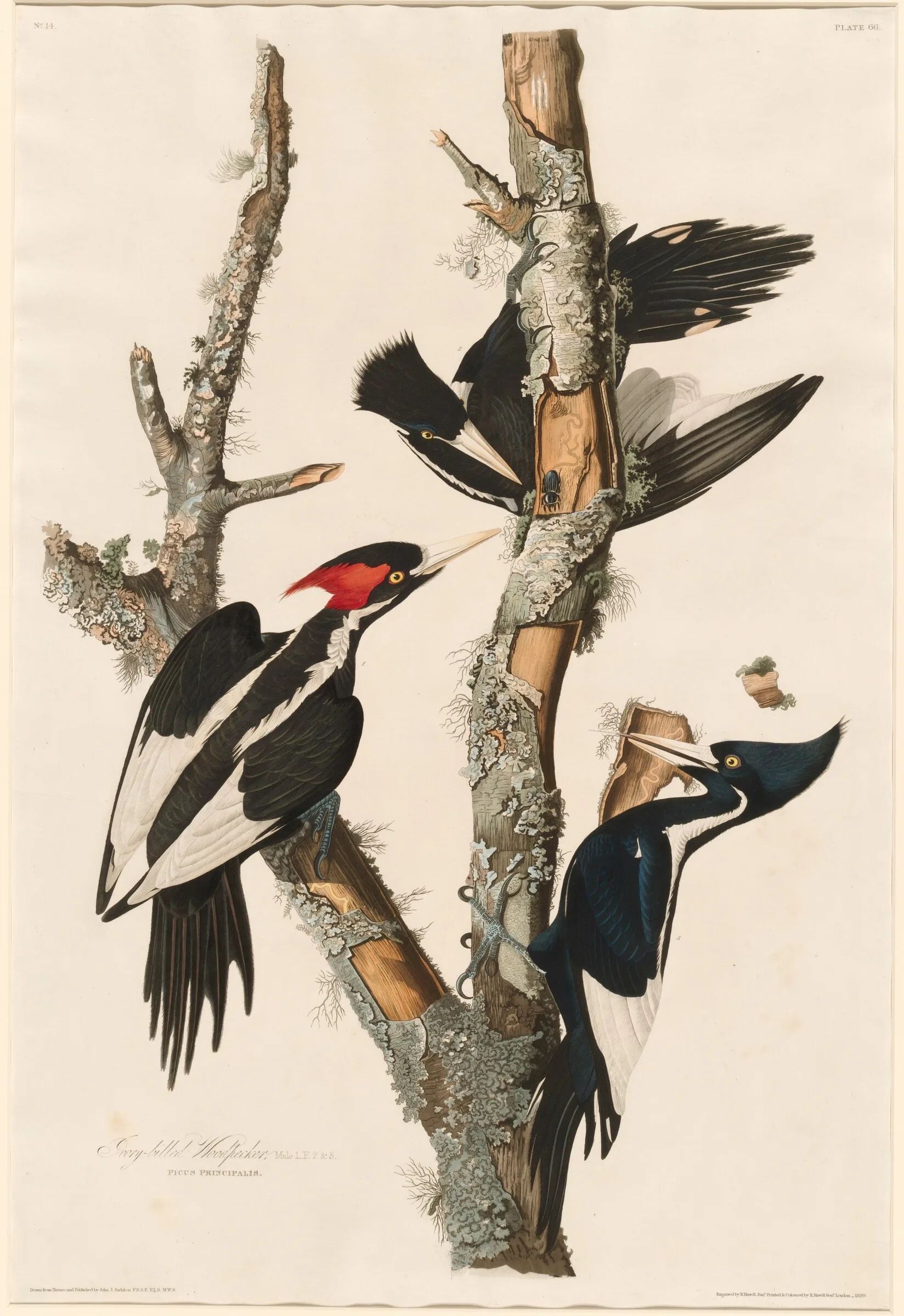
Ivory-billed Woodpecker (Plate 66)
Audubon's “Ivory-billed Woodpecker”, The Birds of America, plate LXVI
Click or press Enter to enlarge
Open the full-resolution image (5219 px, National Gallery of Art)
| Plate | 66 (LXVI) |
|---|---|
| Audubon's name | Ivory-billed Woodpecker |
| Modern name | Ivory-billed Woodpecker |
| Scientific name | Campephilus principalis |
| Status | Possibly extinct |
| Engraved by | Robert Havell, after Audubon's watercolor |
| Date | 1829 |
| Medium | Hand-colored engraving and aquatint on Whatman wove paper |
| Size | plate: 96.7 x 65.2 cm (38 1/16 x 25 11/16 in.) sheet: 99.7 x 67.2 cm (39 1/4 x 26 7/16 in.) |
| Collections | Woodpeckers, Extinct Birds |
| This impression | National Gallery of Art, Washington, 1945.8.66; Gift of Mrs. Walter B. James |
About this plate
Plate 66 shows male and female Ivory-billed Woodpeckers. The male has a scarlet crest and the female a black one, and both have pale ivory bills, broad white wing patches and yellow eyes. Audubon wrote that the bird's bold black, white and carmine reminded him of the paintings of Van Dyck, and that he would call out "There goes a Vandyke!" when he saw one fly.
Audubon placed the species in the great bottomland forests of the South, from the mouth of the Ohio down the Mississippi and west along its tributaries, and from North Carolina south to the Gulf. He wrote that it was shot not as a pest but for its beauty: Native Americans used the scalp and bill to decorate war dress, hunters fixed them to shot pouches, and steamboat travellers bought heads as souvenirs.
The Ivory-billed Woodpecker was the largest woodpecker north of Mexico. It needed large tracts of old swamp forest with many dying trees, where it stripped bark to reach beetle larvae. Logging after the Civil War removed most of that forest. The last widely accepted sightings were in the Singer Tract in Louisiana in the 1940s. Reported sightings in Arkansas in 2004 and later in Louisiana and Florida remain disputed, so it is usually classed as possibly extinct.
In Audubon's words
I have always imagined, that in the plumage of the beautiful Ivory-billed Woodpecker, there is something very closely allied to the style of colouring of the great Vandyke. The broad extent of its dark glossy body and tail, the large and well-defined white markings of its wings, neck, and bill, relieved by the rich carmine of the pendent crest of the male, and the brilliant yellow of its eye, have never failed to remind me of some of the boldest and noblest productions of that inimitable artist's pencil. So strongly indeed have these thoughts become ingrafted in my mind, as I gradually obtained a more intimate acquaintance with the Ivory-billed Woodpecker, that whenever I have observed one of these birds flying from one tree to another, I have mentally exclaimed, "There goes a Vandyke!"
John James Audubon, Ornithological Biography, vol. 1 (1831), “The Ivory-billed Woodpecker”. Read the full chapter.