White-throated Sparrow (Plate 8)
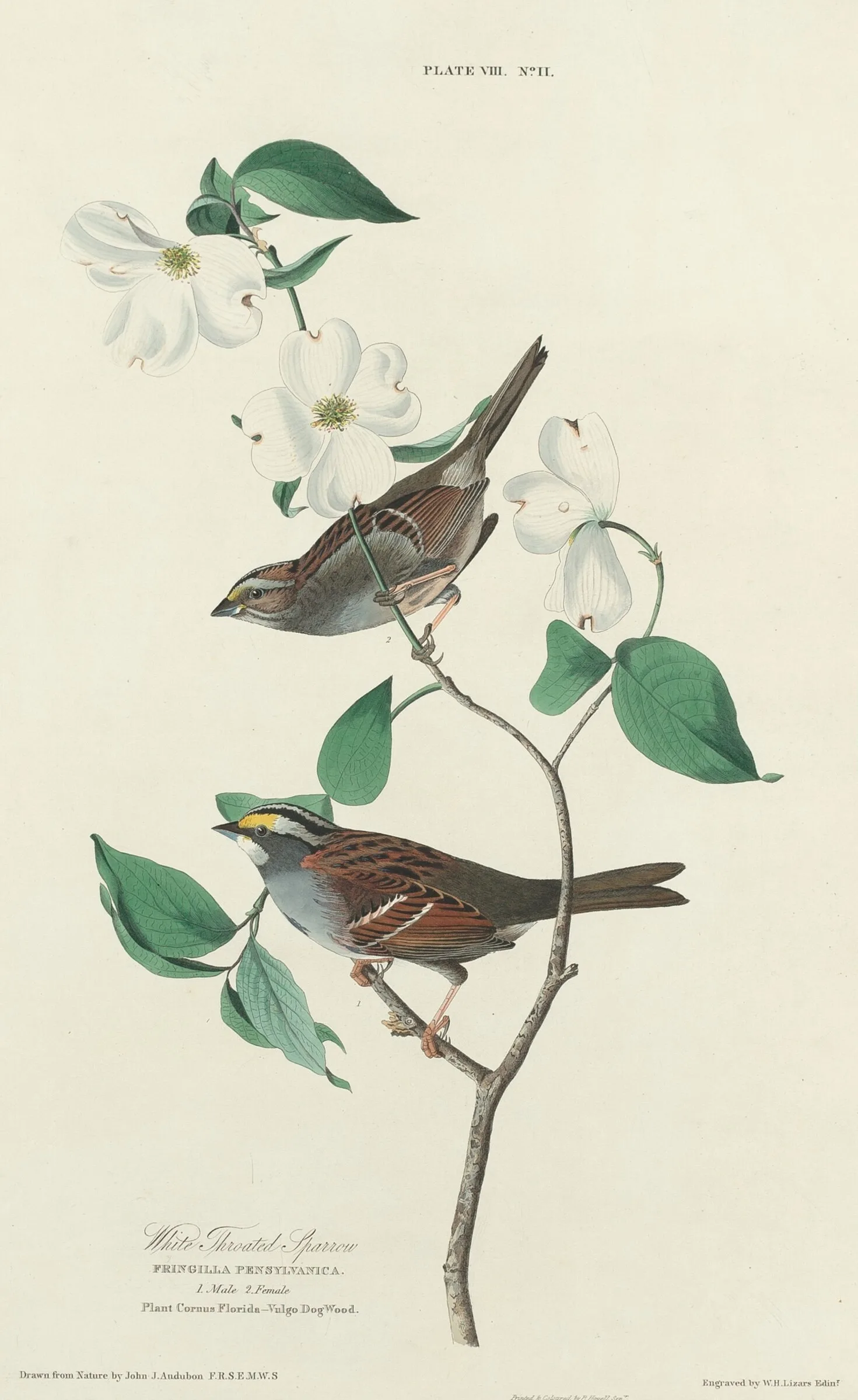
Audubon's “White-throated Sparrow”, The Birds of America, plate VIII
Click or press Enter to enlarge
Open the full-resolution image (2532 px, National Gallery of Art)
| Plate | 8 (VIII) |
|---|---|
| Audubon's name | White-throated Sparrow |
| Modern name | White-throated Sparrow |
| Scientific name | Zonotrichia albicollis |
| Status | Least Concern |
| Engraved by | William Home Lizars, after Audubon's watercolor |
| Date | 1827 |
| Medium | Etching and engraving with hand coloring on Whatman paper |
| Plants and setting | Flowering Dogwood (Cornus florida) in spring bloom |
| Collections | Songbirds |
| This impression | National Gallery of Art, Washington, 1945.8.8; Gift of Mrs. Walter B. James |
About this plate
Plate 8 shows a pair of White-throated Sparrows on a branch of Flowering Dogwood, Cornus florida, in early spring. Audubon wrote that he represented a twig in early spring and described the tree at length, from its hard wood used for turning to the use of its bark against fevers and its berries for black dye. The plate was engraved by William Home Lizars in 1827.
Audubon knew the bird as a short-stay winter visitor to Louisiana, arriving in early November and leaving in early March. He described flocks of thirty to fifty working in hedges of vines, sumac and briars along creeks. They would slip out one by one to scratch for seeds, then dive back into cover at the least noise and sing a brief, plaintive chorus from the tops of the bushes.
The species keeps its name: White-throated Sparrow, Zonotrichia albicollis. Audubon called it Fringilla pennsylvanica. Adults come in two color forms, with white or tan head stripes, and the forms usually pair with the opposite type. This is a well-studied case of a plumage difference tied to a chromosome rearrangement.
The White-throated Sparrow breeds in the conifer and mixed forests of Canada and the northeastern United States, and winters across the eastern and southern states. Its song is often written as Old Sam Peabody or O sweet Canada. It is listed as Least Concern.
In Audubon's words
They form groups, sometimes containing from thirty to fifty individuals, and live together in harmony. They are constantly moving up and down among these recesses, with frequent jerkings of the tail, and uttering a note common to the tribe. From the hedges and thickets they issue one by one in quick succession, and ramble to the distance of eight or ten yards, hopping and scratching, in quest of small seeds, and preserving the utmost silence. When the least noise is heard, or alarm given, and frequently, as I thought, without any alarm at all, they all fly back to their covert, pushing directly into the very thickest part of it. A moment elapses, when they become reassured, and ascending to the highest branches and twigs, open a little concert, which, although of short duration, is extremely sweet.
John James Audubon, Ornithological Biography, vol. 1 (1831), “The White-throated Sparrow”. Read the full chapter.



