Swallow-tailed Kite (Plate 72)
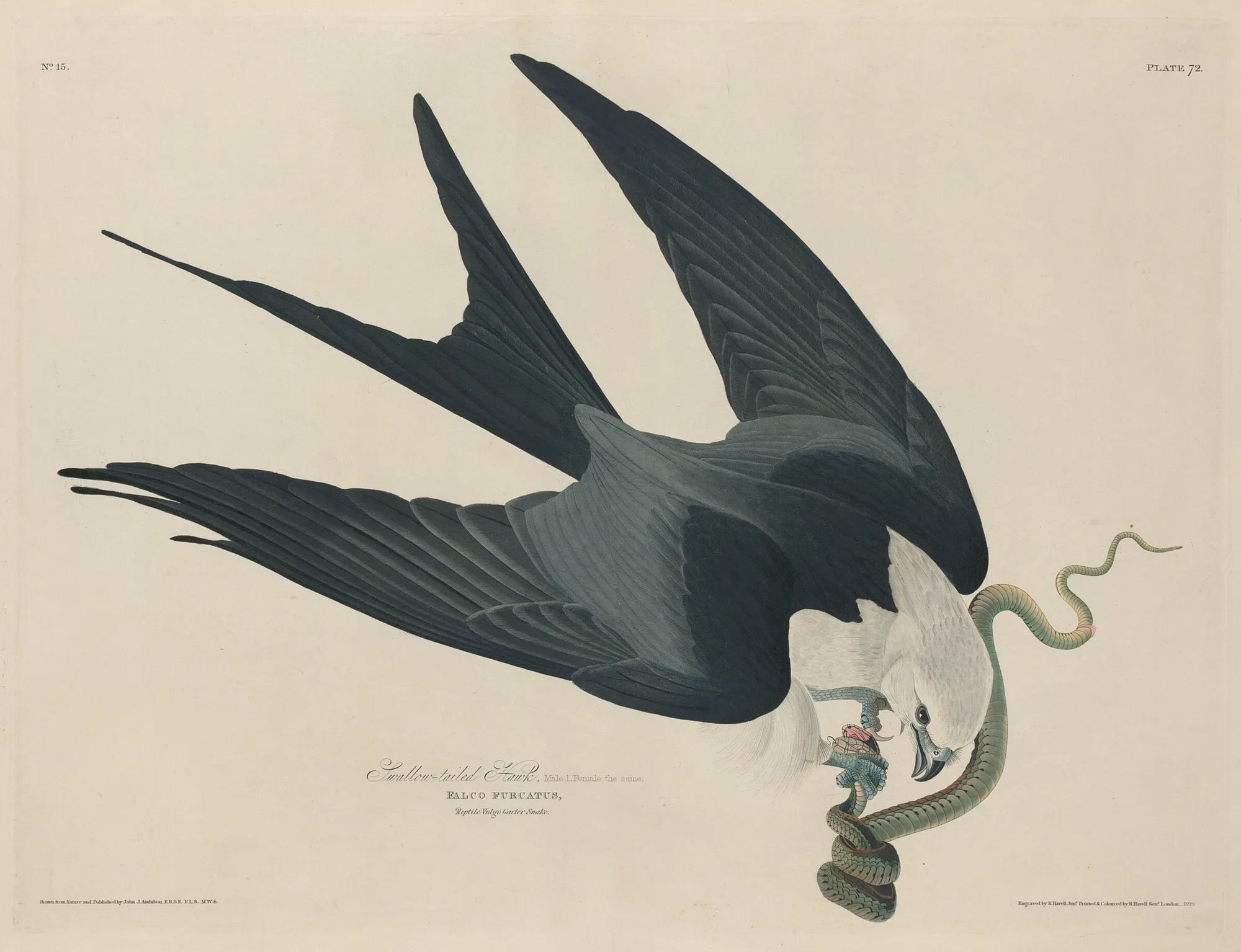
Audubon's “Swallow-tailed Hawk”, The Birds of America, plate LXXII
Click or press Enter to enlarge
Open the full-resolution image (3320 px, National Gallery of Art)
| Plate | 72 (LXXII) |
|---|---|
| Audubon's name | Swallow-tailed Hawk |
| Modern name | Swallow-tailed Kite |
| Scientific name | Elanoides forficatus |
| Status | Least Concern |
| Engraved by | Robert Havell, after Audubon's watercolor |
| Date | 1829 |
| Medium | Hand-colored engraving and aquatint on Whatman wove paper |
| Plants and setting | Garter snake held in the talons |
| Collections | Hawks, Eagles and Falcons |
| This impression | National Gallery of Art, Washington, 1945.8.72; Gift of Mrs. Walter B. James |
About this plate
Plate 72 shows a Swallow-tailed Kite in flight, white below and glossy black above, with its long, deeply forked tail spread as it carries a garter snake in its talons. Audubon noted that these kites take snakes, lizards, frogs, large grasshoppers and caterpillars, seize them without landing, and often eat them in the air.
Audubon admired the bird's flight more than almost any other. He described flocks of fifteen or twenty diving among the trees to snatch insects and lizards from the trunks. He placed it as rare in Virginia and Pennsylvania but common in the lower South, especially on the prairies of the Attakapas and Opelousas districts of Louisiana, and recorded a pair that raised four young near the Falls of the Ohio in 1820.
The Swallow-tailed Kite once bred up the Mississippi valley as far as Minnesota. Its range collapsed in the late 1800s and early 1900s with the clearing of bottomland forest and shooting. In the United States it now breeds mainly in Florida and along the coastal plain from South Carolina to Louisiana and east Texas, and it winters in South America. Other populations live in Central and South America, and the species is listed as Least Concern.
In Audubon's words
The flight of this elegant species of Hawk is singularly beautiful and protracted. It moves through the air with such ease and grace, that it is impossible for any individual, who takes the least pleasure in observing the manners of birds, not to be delighted by the sight of it whilst on wing. Gliding along in easy flappings, it rises in wide circles to an immense height, inclining in various ways its deeply forked tail, to assist the direction of its course, dives with the rapidity of lightning, and, suddenly checking itself, reascends, soars away, and is soon out of sight. At other times a flock of these birds, amounting to fifteen or twenty individuals, is seen hovering around the trees. They dive in rapid succession amongst the branches, glancing along the trunks, and seizing in their course the insects and small lizards of which they are in quest.
John James Audubon, Ornithological Biography, vol. 1 (1831), “The Swallow-tailed Hawk”. Read the full chapter.