Wood Thrush (Plate 73)
Audubon's “Wood Thrush”, The Birds of America, plate LXXIII
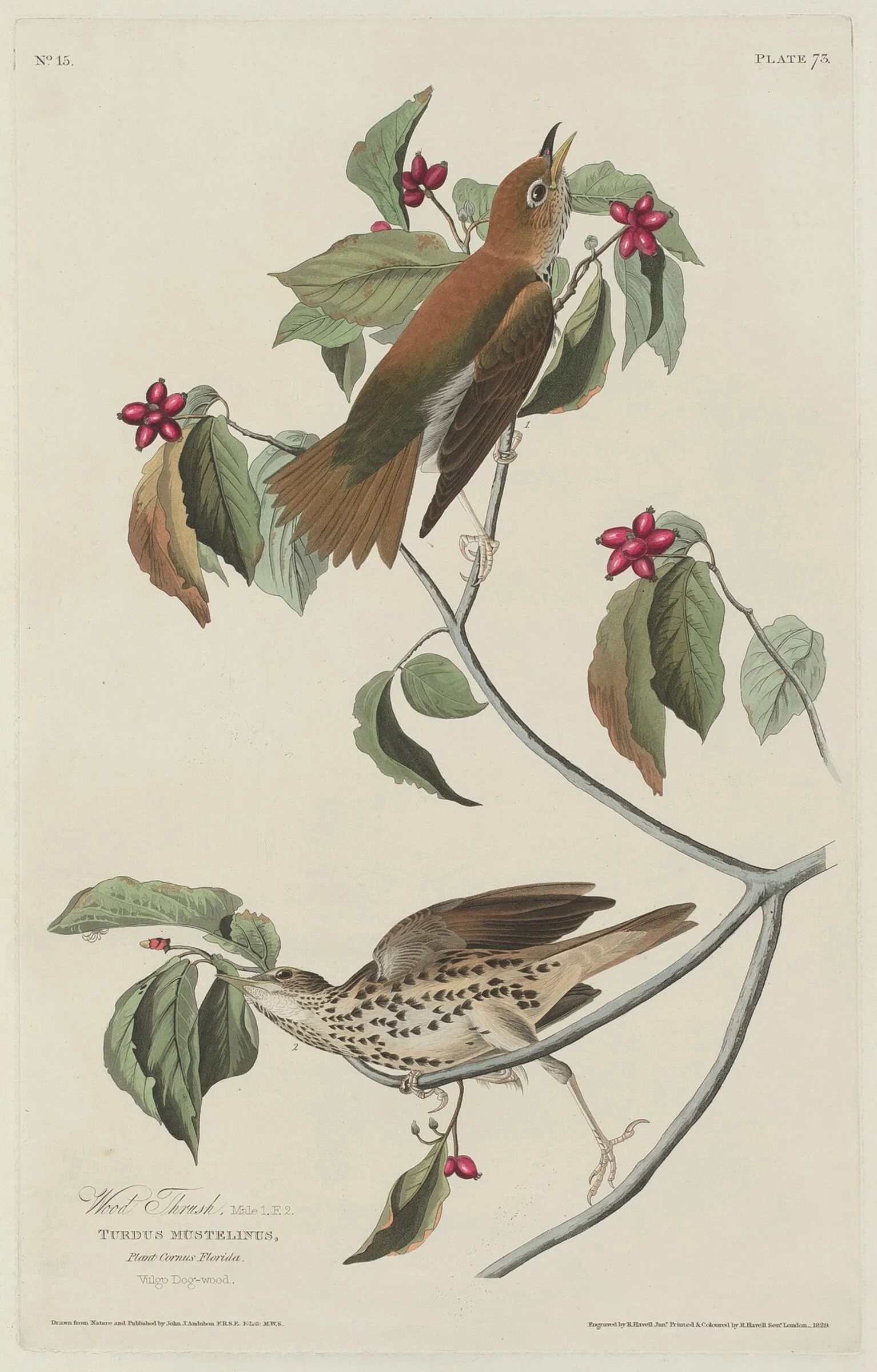
Click or press Enter to enlarge
Open the full-resolution image (2369 px, National Gallery of Art)
| Plate | 73 (LXXIII) |
|---|---|
| Audubon's name | Wood Thrush |
| Modern name | Wood Thrush |
| Scientific name | Hylocichla mustelina |
| Status | Near Threatened |
| Engraved by | Robert Havell, after Audubon's watercolor |
| Date | 1829 |
| Medium | Hand-colored engraving and aquatint on Whatman wove paper |
| Collections | Songbirds |
| This impression | National Gallery of Art, Washington, 1945.8.73; Gift of Mrs. Walter B. James |
About this plate
Plate 73 shows a male and female Wood Thrush, the cinnamon-backed thrush with bold round spots on a white breast. Audubon called it his greatest favourite among the birds of American woods. The chapter opens with a stormy night in a leaking camp and the bird's song at dawn lifting his spirits.
He described the song as few notes, powerful, clear and mellow, rising and falling until barely audible, with several males answering each other toward evening. He placed the bird in the darkest woods along shaded streams. He wrote that the nest is usually set on a low horizontal branch of a dogwood, built of leaves with a layer of mud and grass, and he described the bird's low chuckling note and the alarm it shows at a fox or raccoon.
The Wood Thrush breeds in moist deciduous forest across the eastern United States and southeastern Canada and winters in Central America. The male can sing two notes at once, which gives the song its ringing quality. It is the official bird of the District of Columbia. Breeding Bird Survey data show a steep decline since the 1960s, linked to forest fragmentation, nest predation, cowbird parasitism and loss of wintering forest. It is listed as Near Threatened.
In Audubon's words
The song of the Wood Thrush, although composed of but few notes, is so powerful, distinct, clear, and mellow, that it is impossible for any person to hear it without being struck by the effect which it produces on the mind. I do not know to what instrumental sounds I can compare these notes, for I really know none so melodious and harmonical. They gradually rise in strength, and then fall in gentle cadences, becoming at length as to be scarcely audible; like the emotions of the lover, who at one moment exults in the hope of possessing the object of his affections, and the next pauses in suspense, doubtful of the result of all his efforts to please. Several of these birds seem to challenge each other from different portions of the forest, particularly towards evening, and at that time nearly all the other songsters being about to retire to rest, the notes of the Wood Thrush are doubly pleasing.
John James Audubon, Ornithological Biography, vol. 1 (1831), “The Wood Thrush”. Read the full chapter.



