Indigo Bunting (Plate 74)
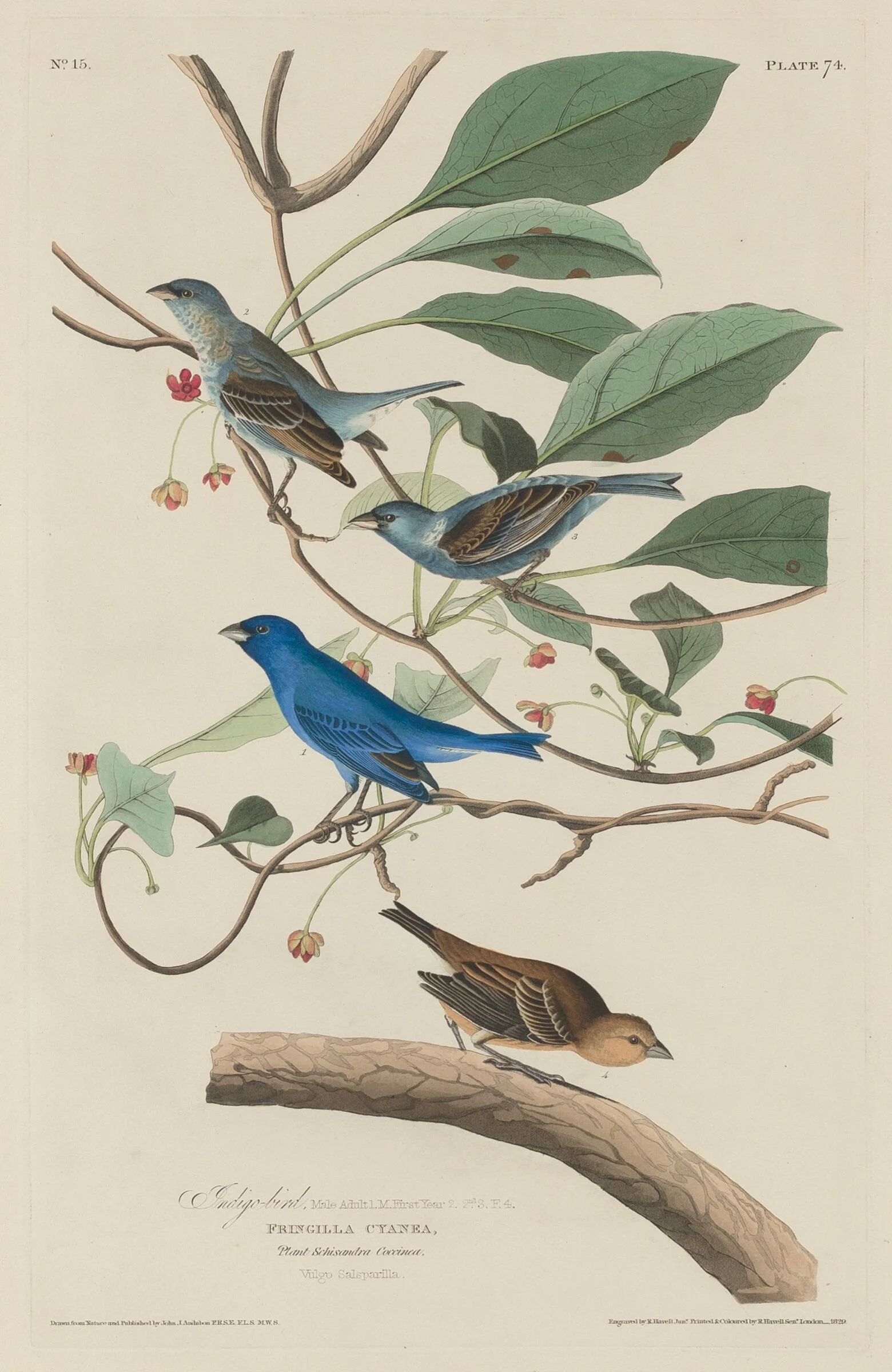
Audubon's “Indigo Bird”, The Birds of America, plate LXXIV
Click or press Enter to enlarge
Open the full-resolution image (2388 px, National Gallery of Art)
| Plate | 74 (LXXIV) |
|---|---|
| Audubon's name | Indigo Bird |
| Modern name | Indigo Bunting |
| Scientific name | Passerina cyanea |
| Status | Least Concern |
| Engraved by | Robert Havell, after Audubon's watercolor |
| Date | 1829 |
| Medium | Hand-colored engraving and aquatint on Whatman wove paper |
| Plants and setting | Wild sarsaparilla (a creeping plant, as named by Audubon) |
| Collections | Songbirds |
| This impression | National Gallery of Art, Washington, 1945.8.74; Gift of Mrs. Walter B. James |
About this plate
Plate 74 shows four Indigo Buntings on a creeping plant Audubon called wild sarsaparilla: an adult female, two young males in their first and second autumn with brown mixed into the blue, and an adult male in full breeding plumage. Audubon said the plant grows on forest edges and in damp places in Louisiana where the birds are found, and was valued as a medicine.
He wrote that the Creoles of Louisiana called the bird Petit Papebleu, since the French settlers called all finches, buntings and orioles papes. He described it arriving from Mexico with the Painted Bunting, being caught in trap-cages, and spreading to the Great Lakes. The male sings from the highest twig of a lone tree for half an hour at a time, a song that falls in cadence through eight or ten notes, and he noted that live birds were sold in Europe.
The male's blue is a structural colour produced by the way feathers scatter light, not by pigment, so he looks black in poor light. Indigo Buntings breed in brushy edges, old fields and roadsides across the eastern and central United States and winter from southern Mexico to Panama and the Caribbean. They migrate at night, and experiments with caged birds in planetariums showed they learn to orient by the stars. The species is common and listed as Least Concern.
In Audubon's words
The Indigo Bird arrives in the Southern States from the direction of Mexico, along with its relative the Painted Finch, and is caught in trap-cages, but with more difficulty than the latter bird. It spreads far and wide over the United States, extending from the borders of our Atlantic shores to those of our great lakes. It is not a forest bird, but prefers the skirts of the woods, the little detached thickets in and along the fields, the meadows, the gardens, and orchards, and is frequently seen hopping along, or perched on a fence, from which it does not disdain to send forth its pretty little song. The highest top of a detached tree is, however, preferred for this purpose, and the Indigo Bird is to be observed perched on this pinnacle, singing at short intervals for half an hour at a time.
John James Audubon, Ornithological Biography, vol. 1 (1831), “The Indigo Bird”. Read the full chapter.



