Carolina Wren (Plate 78)
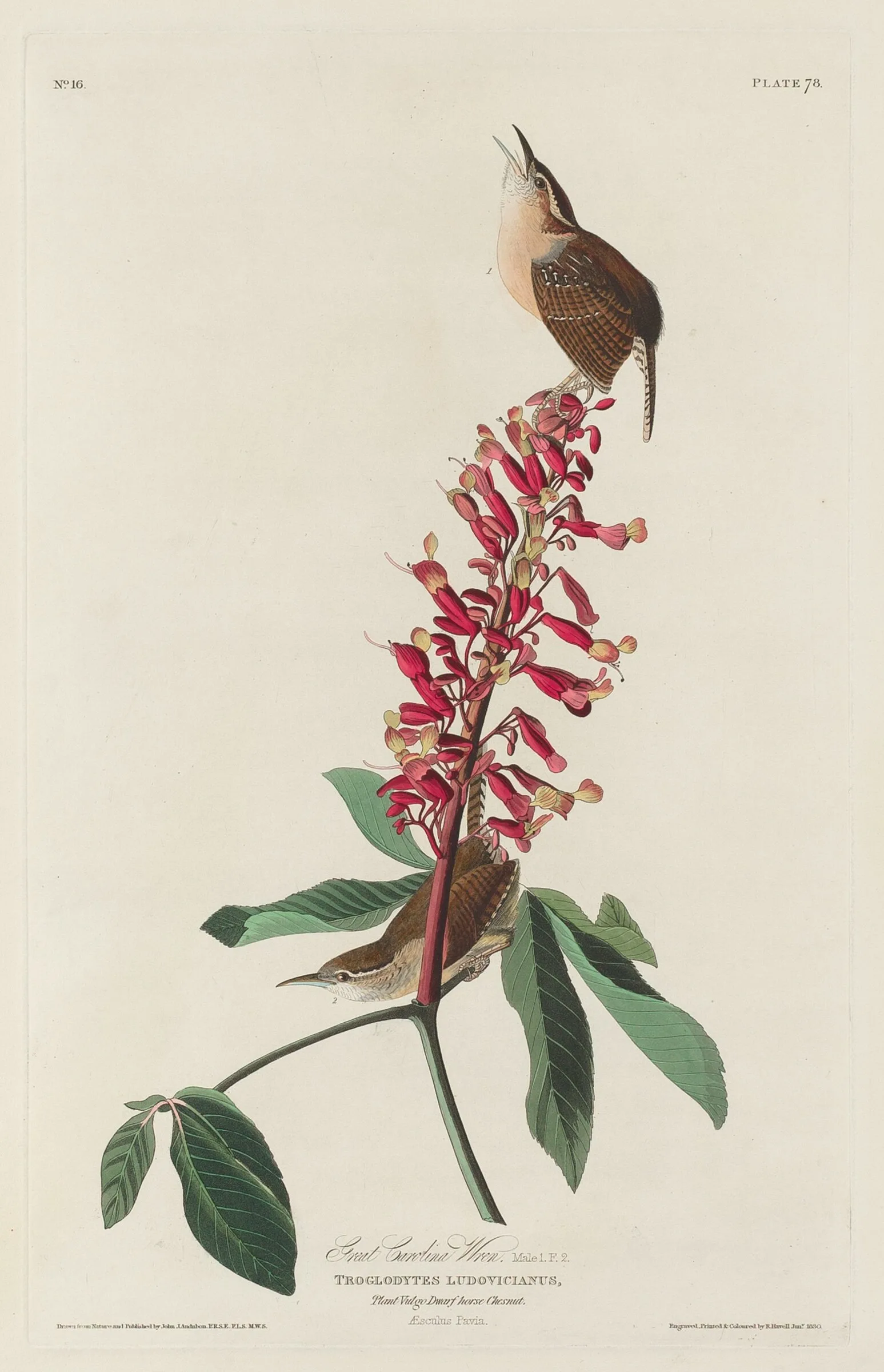
Audubon's “Great Carolina Wren”, The Birds of America, plate LXXVIII
Click or press Enter to enlarge
Open the full-resolution image (2408 px, National Gallery of Art)
| Plate | 78 (LXXVIII) |
|---|---|
| Audubon's name | Great Carolina Wren |
| Modern name | Carolina Wren |
| Scientific name | Thryothorus ludovicianus |
| Status | Least Concern |
| Engraved by | Robert Havell, after Audubon's watercolor |
| Date | 1830 |
| Medium | Hand-colored engraving and aquatint on Whatman wove paper |
| Collections | Songbirds |
| This impression | National Gallery of Art, Washington, 1945.8.78; Gift of Mrs. Walter B. James |
About this plate
Plate 78 shows a male and female Carolina Wren, the warm brown wren with a bold white eyebrow and cocked tail. Audubon studied it in Louisiana, where it lived year round, and argued that a bird is best observed in its own country, where it behaves freely.
He described its short, jerky flights from fence rail to log and through piles of wood and fallen roots, the tail almost always raised and the body bobbing before each hop, all with an angry chirr-up. He compared its speed to a mouse, appearing at a crevice and vanishing in an instant. When fed or tired it stops and sings a loud, mellow song, heard from plantations, swamps, barns, stables and woodpiles close to the house.
The Carolina Wren is the state bird of South Carolina. It lives in thick undergrowth across the southeastern and central United States into northeastern Mexico, and both sexes sing and stay paired all year. Its range has spread north into New England and southern Ontario, helped by milder winters and bird feeders, though hard winters still cut northern populations sharply. It nests in almost any cavity, including mailboxes, boots and hanging plants. It is listed as Least Concern.
In Audubon's words
The quickness of the motions of this active little bird is fully equal to that of the mouse. Like the latter it appears and is out of sight in a moment, peeps into a crevice, passes rapidly through it, and shews itself at a different place the next instant. When satiated with food, or fatigued with these multiplied exertions, the little fellow stops, droops its tail, and sings with great energy a short ditty something resembling the words come-to-me, come-to-me, repeated several times in quick succession, so loud, and yet so mellow, that it is always agreeable to listen to them. During spring, these notes are heard from all parts of the plantations, the damp woods, the swamps, the sides of creeks and rivers, as well as from the barns, the stables and the piles of wood, within a few yards of the house.
John James Audubon, Ornithological Biography, vol. 1 (1831), “The Great Carolina Wren”. Read the full chapter.



