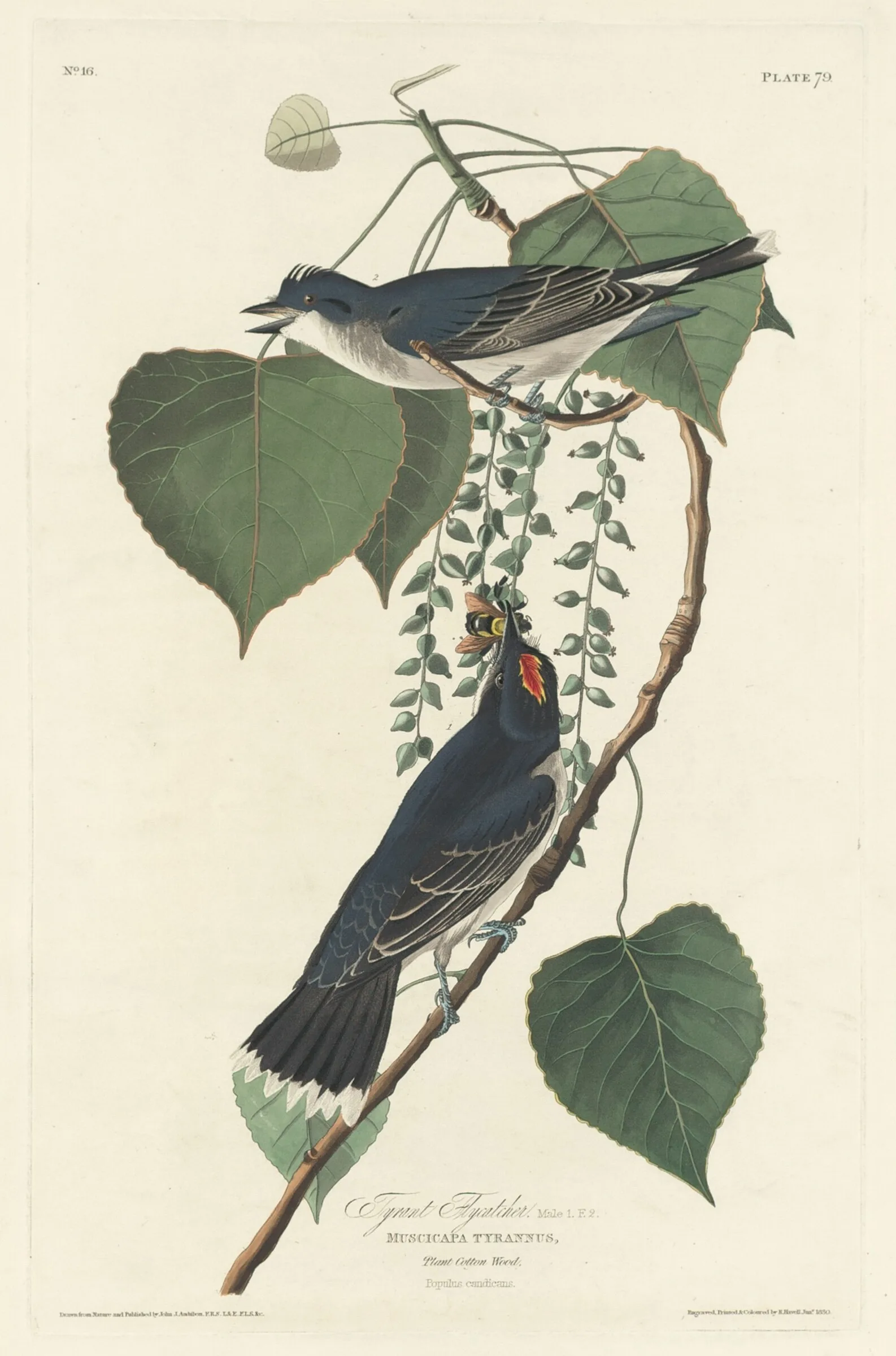
Eastern Kingbird (Plate 79)
Audubon's “Tyrant Flycatcher”, The Birds of America, plate LXXIX
Click or press Enter to enlarge
Open the full-resolution image (2468 px, National Gallery of Art)
| Plate | 79 (LXXIX) |
|---|---|
| Audubon's name | Tyrant Flycatcher |
| Modern name | Eastern Kingbird |
| Scientific name | Tyrannus tyrannus |
| Status | Least Concern |
| Engraved by | Robert Havell, after Audubon's watercolor |
| Date | 1830 |
| Medium | Hand-colored engraving and aquatint on Whatman wove paper |
| Collections | Songbirds |
| This impression | National Gallery of Art, Washington, 1945.8.79; Gift of Mrs. Walter B. James |
About this plate
Plate 79 shows a male and female Eastern Kingbird, dark slate above and white below, with a white band at the tip of the tail. Audubon named the common names of his day: Tyrant Fly-catcher, Field Martin and King Bird.
He opened by defending the bird against farmers who shot it, and its young, because it sometimes ate honey bees. He argued that the farmer killed far more bees to rob their hives. He described its arrival in Louisiana around mid-March, a few silent days of rest, then courtship flights in which the pair hovered on quivering wings twenty or thirty yards up, giving a loud tremulous shriek. Nests were built of twigs and thick layers of cotton, wool or tow, lined with roots and horsehair.
The kingbird's name comes from its boldness. It attacks crows, hawks and herons that come near its nest, sometimes landing on their backs. It breeds in open country with scattered trees across most of North America and migrates to South America, where it lives in flocks in the Amazon basin and eats mostly fruit in winter. It is listed as Least Concern.
In Audubon's words
The love-season is at hand. The male and female are seen moving about through the air, with a continued quivering motion of their wings, at a height of twenty or thirty yards above the ground, uttering a continual, tremulous, loud shriek. The male follows in the wake of the female, and both seem panting for a suitable place in which to form their nest. Meanwhile, they watch the motions of different insects, deviate a little from the course of their playful rounds, and with a sweeping dart secure and swallow the prey in an instant. Probably the next sees them perched on the twig of a tree, close together, and answering the calls of nature. The choice of a place being settled by the happy pair, they procure small dry twigs from the ground, and rising to a horizontal branch, arrange them as the foundation of their cherished home.
John James Audubon, Ornithological Biography, vol. 1 (1831), “The Tyrant Fly-catcher”. Read the full chapter.



