Osprey (Plate 81)
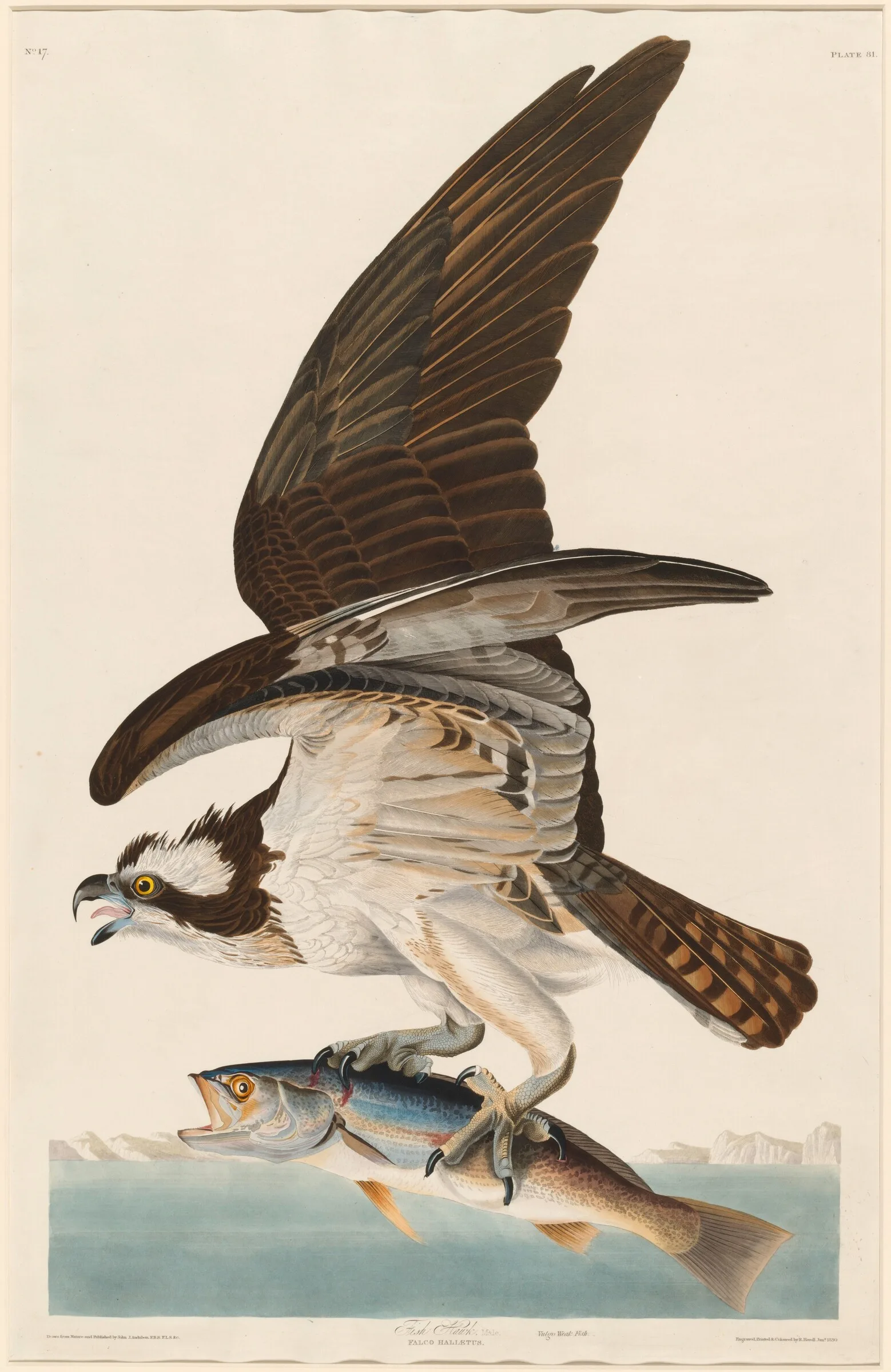
Audubon's “Fish Hawk”, The Birds of America, plate LXXXI
Click or press Enter to enlarge
Open the full-resolution image (5214 px, National Gallery of Art)
| Plate | 81 (LXXXI) |
|---|---|
| Audubon's name | Fish Hawk |
| Modern name | Osprey |
| Scientific name | Pandion haliaetus |
| Status | Least Concern |
| Engraved by | Robert Havell, after Audubon's watercolor |
| Date | 1830 |
| Medium | Hand-colored engraving and aquatint on Whatman wove paper |
| Size | plate: 96.1 x 64 cm (37 13/16 x 25 3/16 in.) sheet: 100 x 66.6 cm (39 3/8 x 26 1/4 in.) |
| Collections | Hawks, Eagles and Falcons |
| This impression | National Gallery of Art, Washington, 1945.8.81; Gift of Mrs. Walter B. James |
About this plate
Plate 81 shows a male Osprey rising with a fish clutched in its talons, the pose Audubon said it takes as it lifts from the water, shakes off the spray and heads to its perch. He said he would have called the bird the Imperial Fisher if he did not live in a republic.
Audubon noted that Ospreys were more sociable than other hawks, migrating in loose groups and nesting close together along the Atlantic shore. Fishermen welcomed their return each spring as a sign that the fish were coming and protected them from gunners. He also observed that the Osprey never takes prey in the air: on the Gulf of Mexico he watched them ignore flying fish in the air and wait until the fish swam again near the surface.
The Osprey is one of the most widespread birds of prey in the world, found on every continent except Antarctica. It feeds almost entirely on live fish, caught by a feet-first plunge, and has a reversible outer toe and spiny foot pads for grip. In the mid twentieth century DDT thinned its eggshells and its numbers crashed in the northeastern United States. After the pesticide was banned in 1972 and nest platforms were put up, it recovered strongly. It is listed as Least Concern.
In Audubon's words
The Fish Hawk differs from all birds of prey in another important particular, which is, that it never attempts to secure its prey in the air, although its rapidity of flight might induce an observer to suppose it perfectly able to do so. I have spent weeks on the Gulf of Mexico, where these birds are numerous, and have observed them sailing and plunging into the water, at a time when numerous shoals of flying-fish were emerging from the sea to evade the pursuit of the dolphins. Yet the Fish Hawk never attempted to pursue any of them while above the surface, but would plunge after one of them or a bonita-fish, after they had resumed their usual mode of swimming near the surface. The motions of the Fish Hawk in the air are graceful, and as majestic as those of the Eagle.
John James Audubon, Ornithological Biography, vol. 1 (1831), “The Fish Hawk, or Osprey”. Read the full chapter.