Eastern Whip-poor-will (Plate 82)
Audubon's “Whip-poor-will”, The Birds of America, plate LXXXII
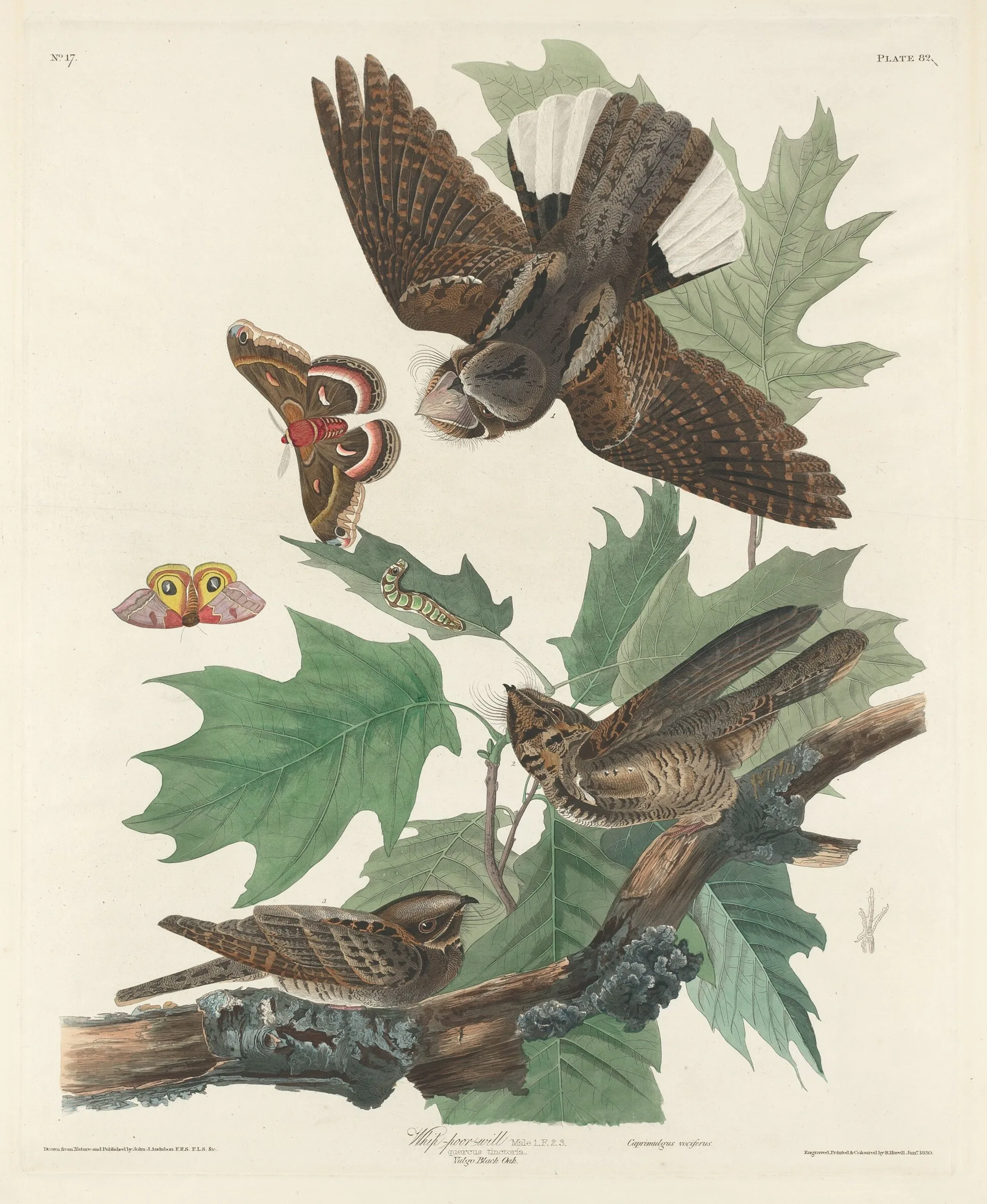
Click or press Enter to enlarge
Open the full-resolution image (3271 px, National Gallery of Art)
| Plate | 82 (LXXXII) |
|---|---|
| Audubon's name | Whip-poor-will |
| Modern name | Eastern Whip-poor-will |
| Scientific name | Antrostomus vociferus |
| Status | Near Threatened |
| Engraved by | Robert Havell, after Audubon's watercolor |
| Date | 1830 |
| Medium | Hand-colored engraving and aquatint on Whatman wove paper |
| Size | plate: 65.2 x 52.5 cm (25 11/16 x 20 11/16 in.) sheet: 99.7 x 67 cm (39 1/4 x 26 3/8 in.) |
| Collections | Songbirds |
| This impression | National Gallery of Art, Washington, 1945.8.82; Gift of Mrs. Walter B. James |
About this plate
Plate 82 shows a male and female Whip-poor-will, nightjars with mottled grey, brown and black plumage that hides them on bark and leaf litter. The male shows white tail corners, which the female lacks. Audubon noted that the bird always sits lengthwise along a branch or log, never across it.
He found it most common in the open Barrens of Kentucky and along the Allegheny ridges, and wrote that it was almost never heard in Louisiana. He described birds sleeping soundly at midday and letting a person walk within a few feet, then setting out at sunset to hunt moths and beetles, flying low over bushes, sallying from fence stakes like a flycatcher, and hovering against tree trunks and banks to pick off ants. Its wings make no sound, and only a low murmur gives it away in the dark.
In 2010 the American Ornithological Society split the Whip-poor-will into the Eastern Whip-poor-will and the Mexican Whip-poor-will of the Southwest. The eastern bird breeds in dry, open woodland from southern Canada to the Gulf states and winters from the Gulf Coast to Central America. It lays two eggs directly on the leaf litter. Its numbers have fallen steeply, probably because of habitat change and the decline of large night-flying insects. It is listed as Near Threatened.
In Audubon's words
No sooner has the sun disappeared beneath the horizon, than this bird bestirs itself, and sets out in pursuit of insects. It passes low over the bushes, moves to the right or left, alights on the ground to secure its prey, passes repeatedly and in different directions over the same field, skims along the skirts of the woods, and settles occasionally on the tops of the fence-stakes or on stumps of trees, from whence it sallies, like a Fly-catcher, after insects, and, on seizing them, returns to the same spot. When thus situated, it frequently alights on the ground, to pick up a beetle. Like the Chuck-will's-widow, it also balances itself in the air, in front of the trunks of trees, or against the sides of banks, to discover ants, and other small insects that may be lurking there.
John James Audubon, Ornithological Biography, vol. 1 (1831), “Whip-poor-will”. Read the full chapter.
Other impressions of this plate: The Metropolitan Museum of Art.



