House Wren (Plate 83)
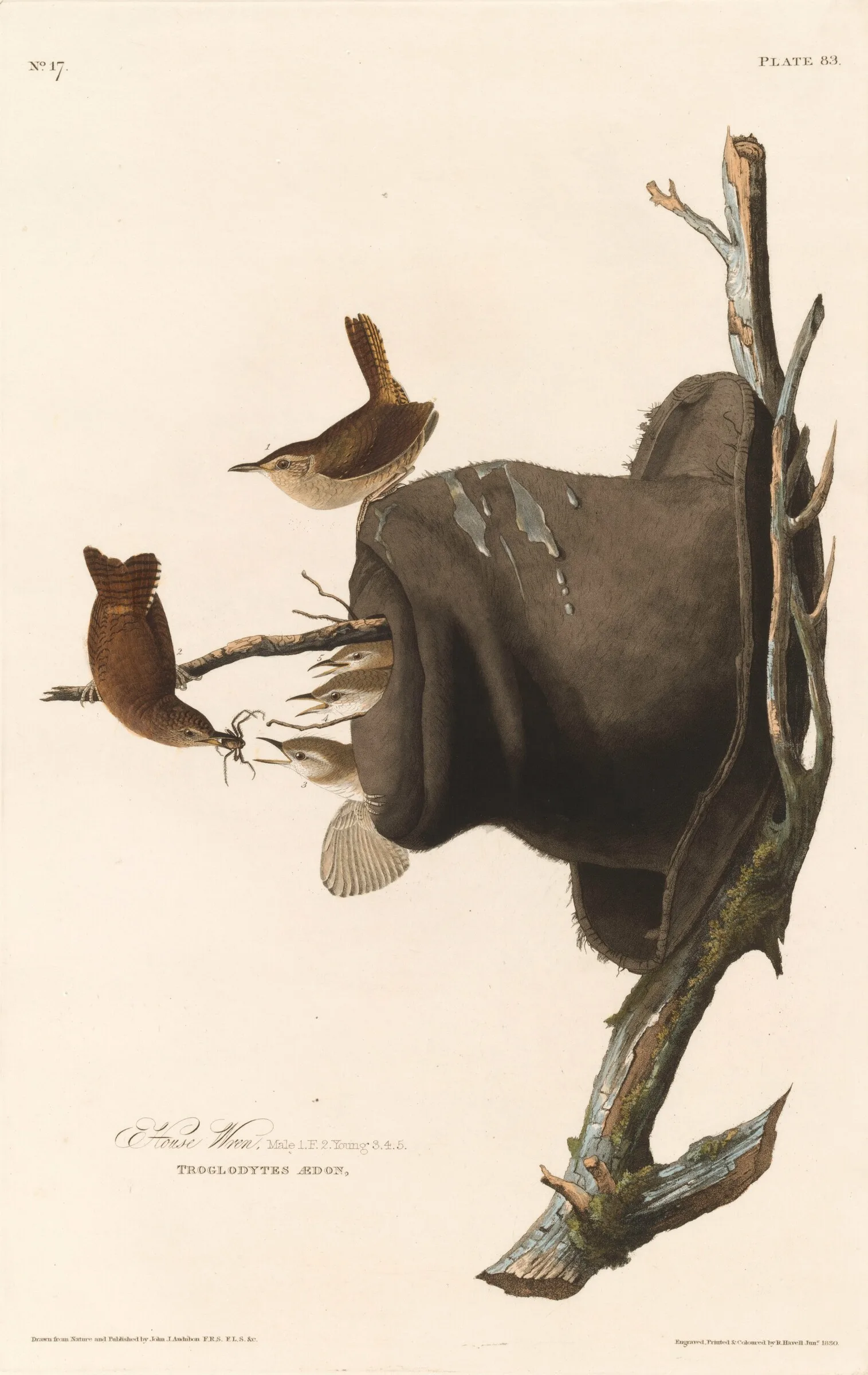
Audubon's “House Wren”, The Birds of America, plate LXXXIII
Click or press Enter to enlarge
Open the full-resolution image (4938 px, National Gallery of Art)
| Plate | 83 (LXXXIII) |
|---|---|
| Audubon's name | House Wren |
| Modern name | House Wren |
| Scientific name | Troglodytes aedon |
| Status | Least Concern |
| Engraved by | Robert Havell, after Audubon's watercolor |
| Date | 1830 |
| Medium | Hand-colored engraving and aquatint on Whatman wove paper |
| Size | plate: 49 x 31 cm (19 5/16 x 12 3/16 in.) sheet: 99.5 x 67 cm (39 3/16 x 26 3/8 in.) |
| Plants and setting | Nest in a discarded hat |
| Collections | Songbirds |
| This impression | National Gallery of Art, Washington, 1945.8.83; Gift of Mrs. Walter B. James |
About this plate
Plate 83 shows a family of House Wrens nesting in an old hat. The young peer out and cling to the side as their mother arrives with a spider, while the male keeps watch. Audubon wrote that the wren nests in almost any cavity, from a hollow apple branch to the pocket of a broken-down carriage, and many in old hats like the one shown.
The bird perched on the hat had a story of its own. In Pennsylvania a pair nested in a hole in the wall a few inches from the room where Audubon drew. The male sang near Audubon and his wife as he worked, took flies and spiders he tossed to it, and began to enter the room. One morning he shut the window, caught it, held it in his hand while he finished its likeness, and set it free. It never came inside again, and it is the bird shown perched on the hat. He also described the wren's hatred of cats, its fights with Purple Martins, and fledglings following their parents through currant bushes like mice.
Audubon wrote that the House Wren never occurs in Louisiana, but it does winter in the Gulf states; he may have missed it because it is quiet and secretive in winter. As now defined, the House Wren breeds from southern Canada to Tierra del Fuego, one of the widest ranges of any American songbird. It readily uses nest boxes, and males fill several cavities with sticks before a female chooses one. It is listed as Least Concern.
In Audubon's words
Now and then, its nest may be seen in the hollow branch of an apple tree. I knew of one in the pocket of an old broken-down carriage, and many in such an old hat as you see represented in the plate, which, if not already before you, I hope you will procure, and look at the little creatures anxiously peeping out or hanging to the side of the hat, to meet their mother, which has just arrived with a spider, whilst the male is on the lookout, ready to interpose should any intruder come near. The same nest is often resorted to for several successive years, merely receiving a little mending. The familiarity of the House Wren is extremely pleasing. In Pennsylvania a pair of these birds had formed a nest, and the female was sitting in a hole of the wall, within a few inches of my (literally so-called) drawing-room.
John James Audubon, Ornithological Biography, vol. 1 (1831), “The House Wren”. Read the full chapter.



