Blue-gray Gnatcatcher (Plate 84)
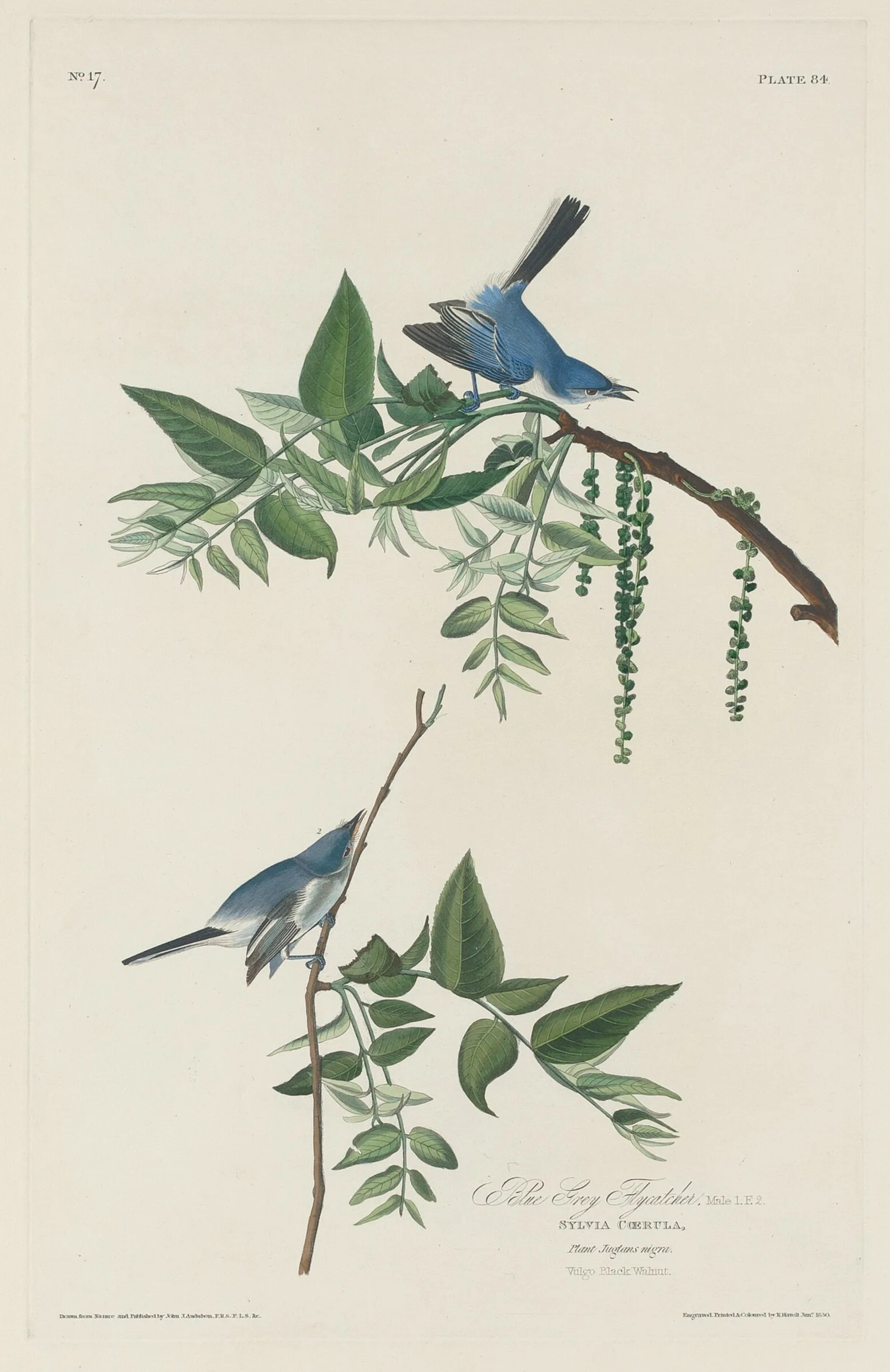
Audubon's “Blue-grey Flycatcher”, The Birds of America, plate LXXXIV
Click or press Enter to enlarge
Open the full-resolution image (2398 px, National Gallery of Art)
| Plate | 84 (LXXXIV) |
|---|---|
| Audubon's name | Blue-grey Flycatcher |
| Modern name | Blue-gray Gnatcatcher |
| Scientific name | Polioptila caerulea |
| Status | Least Concern |
| Engraved by | Robert Havell, after Audubon's watercolor |
| Date | 1830 |
| Medium | Hand-colored engraving and aquatint on Whatman wove paper |
| Size | plate: 49.2 x 31.1 cm (19 3/8 x 12 1/4 in.) sheet: 99.4 x 66.7 cm (39 1/8 x 26 1/4 in.) |
| Plants and setting | Black walnut (Juglans nigra), twig with catkins |
| Collections | Songbirds |
| This impression | National Gallery of Art, Washington, 1945.8.84; Gift of Mrs. Walter B. James |
About this plate
Plate 84 shows a male and female Blue-gray Gnatcatcher on a twig of black walnut with its hanging catkins. The male has a thin black line across the forehead, which the female lacks. Audubon noted that walnut wood was used for furniture and gunstocks, and that the tree grows best in rich bottomland along rivers.
He began with the bird's role as a common foster parent of the young Cow Bunting, now the Brown-headed Cowbird of plate 99, whose female lays her egg in its nest. He described the gnatcatcher reaching New Orleans in mid-March and working through golden willows along the water for mosquitoes and other small insects, hanging from buds at the tips of branches, flicking its tail, and snapping insects from the air.
The Blue-gray Gnatcatcher is a tiny, long-tailed songbird of open woods and scrub. It builds a small cup of plant down and spider silk covered with lichen, saddled on a branch. Its range has spread north since the early twentieth century into New England, southern Ontario and the upper Midwest. It breeds across the eastern and southwestern United States and Mexico and winters from the Gulf states to Central America and Cuba. It is listed as Least Concern.
In Audubon's words
The Blue-grey Fly-catcher arrives in the neighbourhood of New Orleans about the middle of March, when it is observed along the water-courses, flitting about and searching diligently, amidst the branches of the Golden Willow, for the smaller kinds of winged insects, devouring amongst others great numbers of moschettoes. Its flight resembles that of the Long-tailed Titmouse of Europe. It moves to short distances, vibrating its tail while on wing, and, on alighting, is frequently seen hanging to the buds and bunches of leaves, at the extremities of the branches of trees. It seldom visits the interior of the forests, in any portion of our country, but prefers the skirts of woods along damp or swampy places, and the borders of creeks, pools, or rivers. It seizes insects on wing with great agility, snapping its bill like a true Fly-catcher, now and then making little sallies after a group of those diminutive flies that seem as if dancing in the air, and cross each other in their lines of flight, in a thousand various ways.
John James Audubon, Ornithological Biography, vol. 1 (1831), “The Blue-grey Fly-catcher”. Read the full chapter.



