Yellow-throated Warbler (Plate 85)
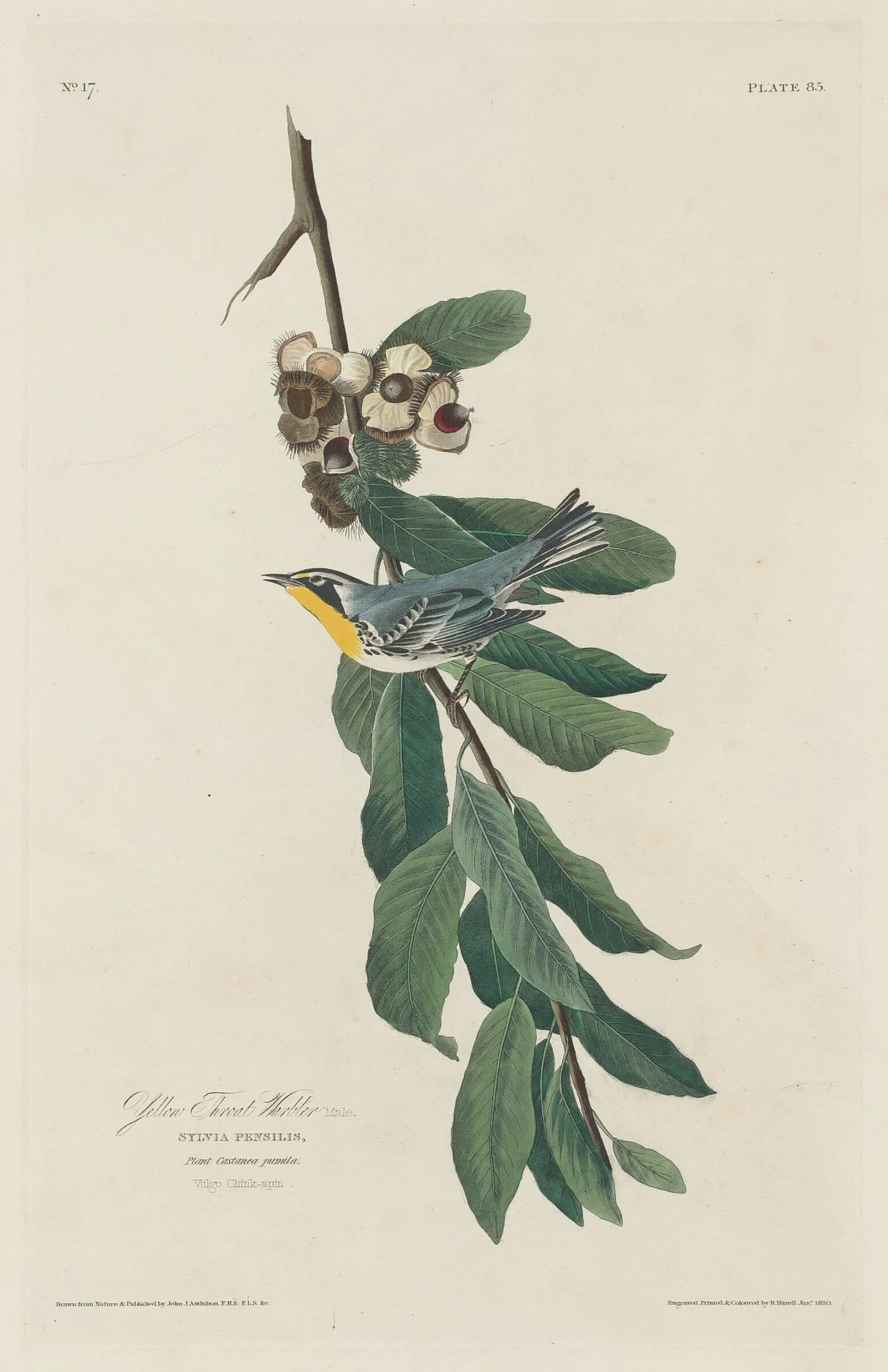
Audubon's “Yellow-throated Warbler”, The Birds of America, plate LXXXV
Click or press Enter to enlarge
Open the full-resolution image (2373 px, National Gallery of Art)
| Plate | 85 (LXXXV) |
|---|---|
| Audubon's name | Yellow-throated Warbler |
| Modern name | Yellow-throated Warbler |
| Scientific name | Setophaga dominica |
| Status | Least Concern |
| Engraved by | Robert Havell, after Audubon's watercolor |
| Date | 1830 |
| Medium | Hand-colored engraving and aquatint on Whatman wove paper |
| Plants and setting | Chinquapin (Castanea pumila) |
| Collections | Songbirds |
| This impression | National Gallery of Art, Washington, 1945.8.85; Gift of Mrs. Walter B. James |
About this plate
Plate 85 shows a male Yellow-throated Warbler on a branch of chinquapin, a shrubby chestnut. The bird has a bright yellow throat, black face mask and white neck patch, with grey upperparts and black streaks along the flanks.
Audubon wrote that the species leaves Louisiana only in December and January and returns in February by thousands to the cypress woods and canebrakes. He noted that it forages more like a creeper than a warbler, moving up, down and around the trunks and branches of tall cypresses and dropping to the roots, and that he never saw it chase insects in the air. He described the nest of grey lichen and moss lined with Spanish moss on a high cypress limb, very hard to see from below.
The Yellow-throated Warbler breeds in the southeastern United States, often in bald cypress swamps, live oaks with Spanish moss, and pine woods, and has spread north up the Ohio valley. Many winter from the Gulf Coast to the Caribbean and Central America. This chapter is followed in the Ornithological Biography by an essay on Louisville, Kentucky, where Audubon and his wife settled in 1808. The species is listed as Least Concern.
In Audubon's words
Their habits are very different from those of the Warblers, and are more in general accordance with those of the Certhiæ. They move up and down, sidewise and spirally, along the trunks, branches, and even twigs of the tallest and largest Cypresses, or such other trees as are found intermingled with them. They are extremely active, in fact, fully as much so as the little Brown Creeper itself. Like it, they suddenly leave the uppermost branches or higher parts of the trunks, and diving downwards alight on the roots, and renew their search after small insects and larvæ. I never saw any of them pursue insects on wing. The nest of this species is prettily constructed. Its outer parts are composed of grey lichens and soft mosses, the interior of silky substances and a few fibres of the Spanish moss.
John James Audubon, Ornithological Biography, vol. 1 (1831), “The Yellow-throated Warbler”. Read the full chapter.



