Harlan's Hawk (Plate 86)
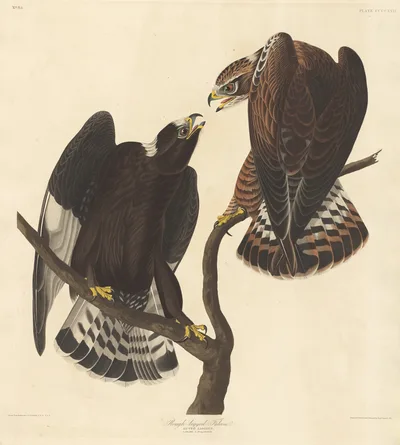
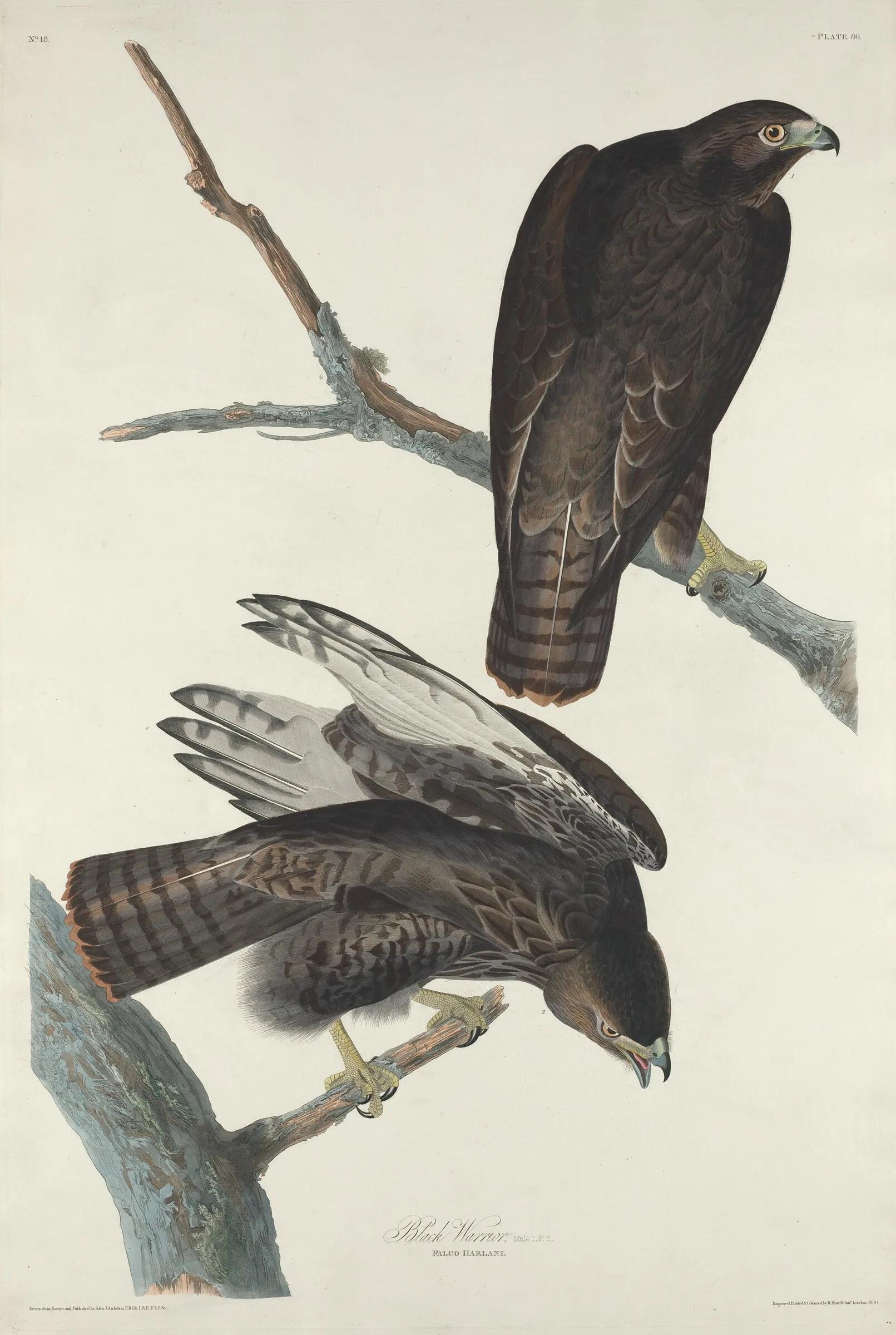
Audubon's “Black Warrior”, The Birds of America, plate LXXXVI
Click or press Enter to enlarge
Open the full-resolution image (4713 px, National Gallery of Art)
| Plate | 86 (LXXXVI) |
|---|---|
| Audubon's name | Black Warrior |
| Modern name | Red-tailed Hawk (Harlan's, dark form) |
| Scientific name | Buteo jamaicensis harlani |
| Status | Least Concern |
| Engraved by | Robert Havell, after Audubon's watercolor |
| Date | 1830 |
| Medium | Hand-colored engraving and aquatint on Whatman wove paper |
| Collections | Hawks, Eagles and Falcons |
| This impression | National Gallery of Art, Washington, 1945.8.86; Gift of Mrs. Walter B. James |
About this plate
Plate 86 shows a male and female of the dark hawk Audubon called the Black Warrior, chocolate brown with streaked underparts and a barred tail. He named it Falco harlani after his friend Dr Richard Harlan of Philadelphia, having waited for a bird large enough to match his gratitude.
He found the pair near St Francisville, Louisiana. Crossing a cotton field, he saw the female on top of a tall tree, wounded her when she passed overhead, and drew her alive. She refused food and died within days, and he later gave her skin to the British Museum through J. G. Children. The male stayed wary of a man with a gun but let Audubon and his wife ride past when unarmed. After nearly two weeks of trying, their physician Dr John B. Hereford winged it with a rifle ball and sent it to him alive.
Harlan's Hawk is now treated as a subspecies of the Red-tailed Hawk, Buteo jamaicensis harlani, though some authorities have argued it deserves full species status. Most are dark, with tails that are mottled white and grey rather than red. It breeds in Alaska and northwestern Canada and winters mainly on the southern Great Plains and in the lower Mississippi valley, which is where Audubon met it. The Red-tailed Hawk is listed as Least Concern.
In Audubon's words
The Hawks now before you were discovered near St Francisville, in Louisiana, during my late sojourn in that State, and had bred in the neighbourhood of the place where I procured them, for two seasons, although they had always eluded my search, until, at last, as I was crossing a large cotton field, one afternoon, I saw the female represented in the Plate standing perched on the top of a high belted tree in an erect and commanding attitude. It looked so like the Black Hawk (Falco niger) of Wilson, that I apprehended what I had heard respecting it might prove incorrect. I approached it, however, when, as if it suspected my evil intentions, it flew off, but after at first sailing as if with the view of escaping from me, passed over my head, when I shot at it, and brought it winged to the ground.
John James Audubon, Ornithological Biography, vol. 1 (1831), “The Black Warrior”. Read the full chapter.