Florida Scrub-Jay (Plate 87)
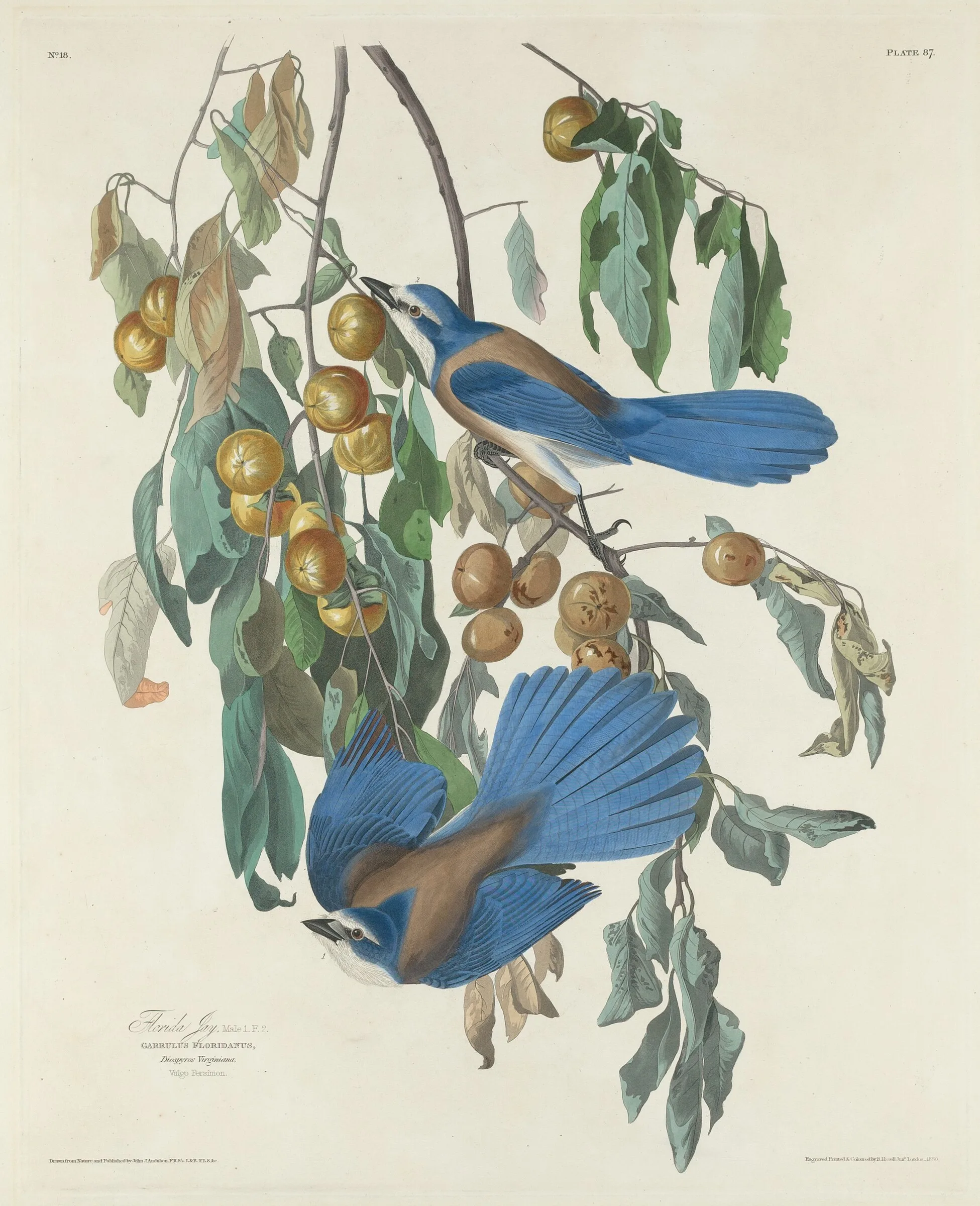
Audubon's “Florida Jays”, The Birds of America, plate LXXXVII
Click or press Enter to enlarge
Open the full-resolution image (3247 px, National Gallery of Art)
| Plate | 87 (LXXXVII) |
|---|---|
| Audubon's name | Florida Jays |
| Modern name | Florida Scrub-Jay |
| Scientific name | Aphelocoma coerulescens |
| Status | Vulnerable |
| Engraved by | Robert Havell, after Audubon's watercolor |
| Date | 1830 |
| Medium | Hand-colored engraving and aquatint on Whatman wove paper |
| Plants and setting | Persimmon (Diospyros virginiana) |
| Collections | Songbirds |
| This impression | National Gallery of Art, Washington, 1945.8.87; Gift of Mrs. Walter B. James |
About this plate
Plate 87 shows Florida Scrub-Jays on a branch of persimmon with its fruit. The birds are blue on the head, wings and tail, with a grey-brown back, a whitish throat and a faint blue necklace. They have no crest, unlike the Blue Jay.
Audubon wrote that the species lives only in Florida and corrected Charles Bonaparte, who had said it occurred in Louisiana and Kentucky. He described its low flight from bush to bush, its softer notes than the Blue Jay's, its quick, abrupt movements, and its habit of dropping to the ground at the edges of marshy places to hunt snails. He noted that it was tame in the breeding season and more shy at other times.
The Florida Scrub-Jay is the only bird species found only in Florida. It lives in oak scrub on old sandy ridges, a habitat that has been largely cleared for citrus, housing and development and that needs regular fire to stay open. Families stay together, and young birds remain for years as helpers at their parents' nest, which made the species a classic case in studies of cooperative breeding. It is listed as Vulnerable and is federally Threatened in the United States.
In Audubon's words
The flight of the Florida Jay is generally performed at a short distance from the ground, and consists either of a single sailing sweep, as it shifts from one tree or bush to another, or of continuous flappings, with a slightly undulated motion, in the manner of the Magpie (Corvus Pica) or of the Canada Jay (Corvus canadensis). Its notes are softer than those of its relative the Blue Jay (Corvus cristatus), and are more frequently uttered. Its motions are also more abrupt and quicker. It is seen passing from one tree to another with expanded tail, stopping for a moment to peep at the intruder, and hopping off to another place the next minute. It frequently descends to the ground, along the edges of oozy or marshy places, to search for snails, of which, together with berries of various kinds, fruits and insects, its food consists.
John James Audubon, Ornithological Biography, vol. 1 (1831), “The Florida Jay”. Read the full chapter.



