Autumnal Warbler (Bay-breasted Warbler) (Plate 88)
Audubon's “Autumnal Warbler”, The Birds of America, plate LXXXVIII
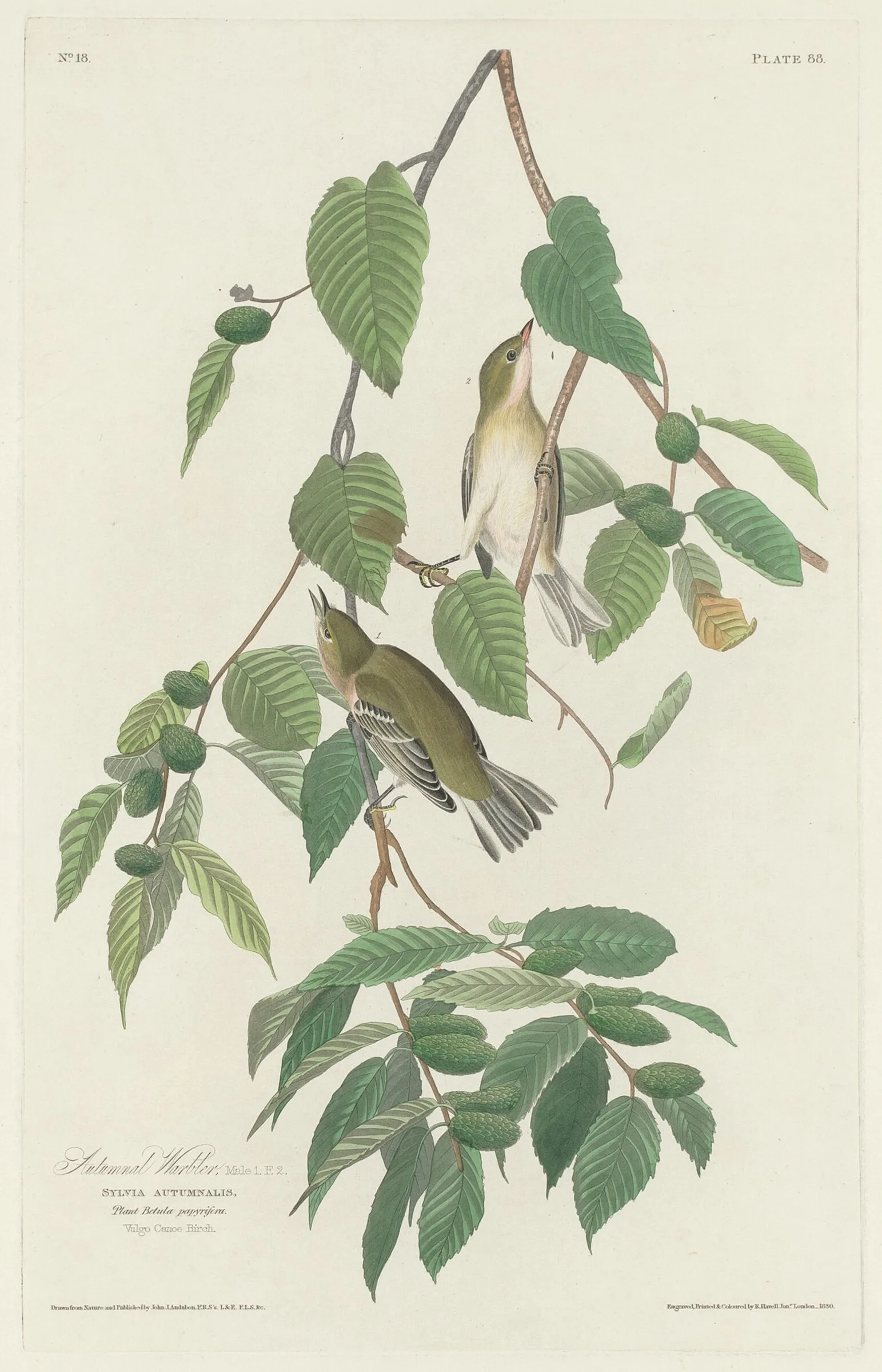
Click or press Enter to enlarge
Open the full-resolution image (2481 px, National Gallery of Art)
| Plate | 88 (LXXXVIII) |
|---|---|
| Audubon's name | Autumnal Warbler |
| Modern name | Bay-breasted Warbler (immature, fall plumage) |
| Scientific name | Setophaga castanea |
| Status | Least Concern |
| Engraved by | Robert Havell, after Audubon's watercolor |
| Date | 1830 |
| Medium | Hand-colored engraving and aquatint on Whatman wove paper |
| Plants and setting | Canoe birch, or paper birch (Betula papyrifera) |
| Collections | Songbirds |
| This impression | National Gallery of Art, Washington, 1945.8.88; Gift of Mrs. Walter B. James |
About this plate
Plate 88 shows a male and female of what Audubon, following Alexander Wilson, called the Autumnal Warbler, small olive-green warblers with white wing bars, perched on a branch of canoe birch. Audubon described the birch as a tree of the northern states that reaches seventy or eighty feet.
Wilson named the bird from fall migrants near Philadelphia. The fall plumages of several warblers look alike, and the Autumnal Warbler is now usually taken to be a young Bay-breasted Warbler in its first fall, though some writers have suggested a fall Blackpoll Warbler. Neither was understood as a separate plumage in Wilson's time. Audubon painted the adult Bay-breasted Warbler as plate 69.
Audubon's account mixes observations that are hard to place. He described the bird passing through Louisiana in great numbers in March, and claimed to have found it breeding near the Cayuga Lakes, on Lake Champlain and in the Great Pine Swamp of Pennsylvania, with a pensile nest in the fork of a low bush. Those breeding notes do not fit the Bay-breasted Warbler, which nests in spruce-fir forest farther north, so they likely belong to another species. The Bay-breasted Warbler is listed as Least Concern.
In Audubon's words
This species makes its appearance in great numbers, in the lower parts of Louisiana, early in March, and remains there for a few days along with many others. At this season, it passes from the high top of one tree to that of another, with great activity. In about a week after its first appearance, none are to be seen. It moves towards the northernmost of our Eastern Districts, as the season advances, and does not stop until it reaches the remote parts of the State of New York, many individuals, however, forcing their way still farther. I have found it breeding in the immediate vicinity of the Cayuga Lakes, and on the borders of Lake Champlain, in retired parts of the woods, which it seems to prefer during the summer months.
John James Audubon, Ornithological Biography, vol. 1 (1831), “The Autumnal Warbler”. Read the full chapter.



