Nashville Warbler (Plate 89)
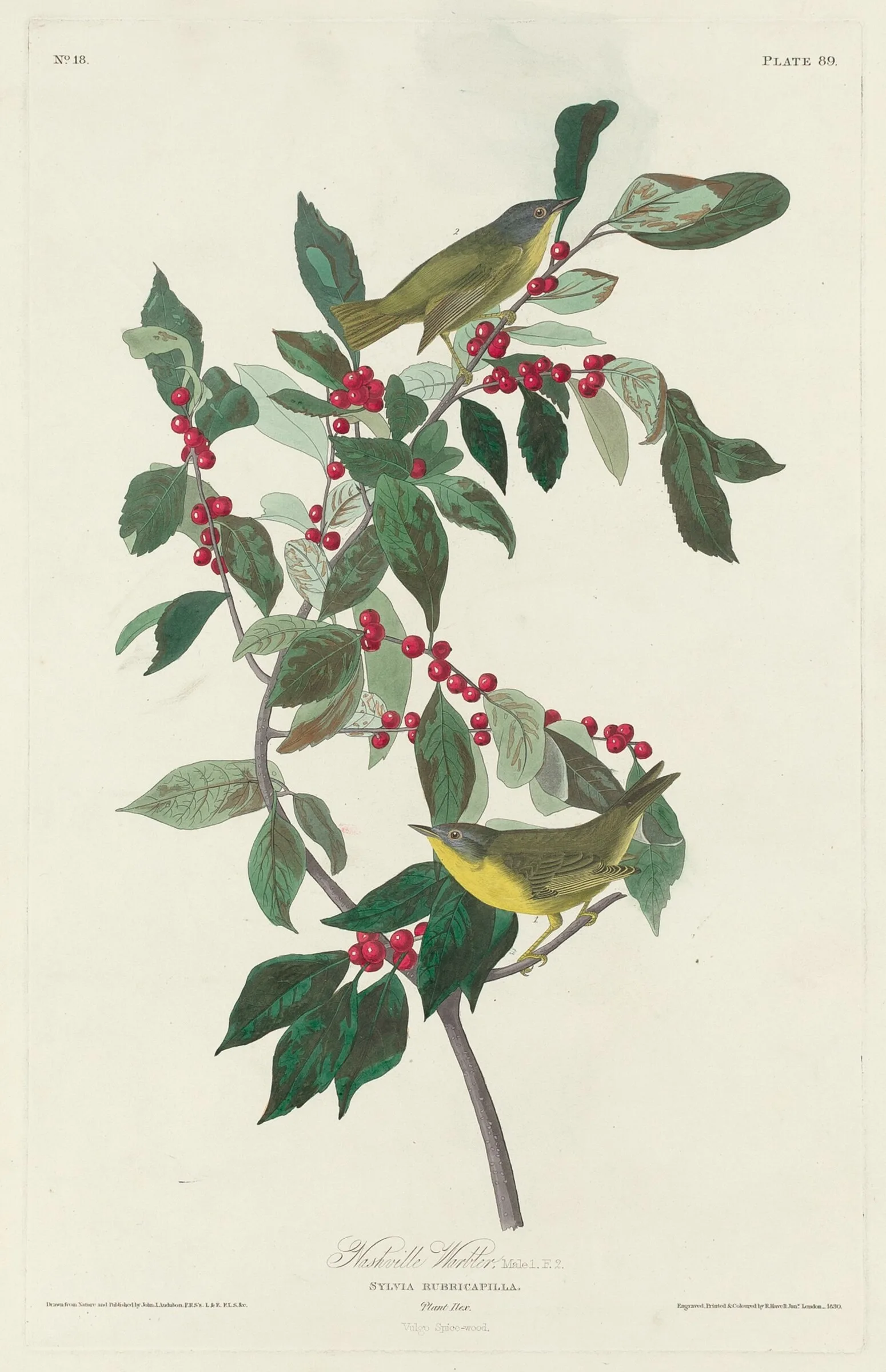
Audubon's “Nashville Warbler”, The Birds of America, plate LXXXIX
Click or press Enter to enlarge
Open the full-resolution image (2467 px, National Gallery of Art)
| Plate | 89 (LXXXIX) |
|---|---|
| Audubon's name | Nashville Warbler |
| Modern name | Nashville Warbler |
| Scientific name | Leiothlypis ruficapilla |
| Status | Least Concern |
| Engraved by | Robert Havell, after Audubon's watercolor |
| Date | 1830 |
| Medium | Hand-colored engraving and aquatint on Whatman wove paper |
| Plants and setting | Swamp spice (Ilex prinoides of Audubon's text) |
| Collections | Songbirds |
| This impression | National Gallery of Art, Washington, 1945.8.89; Gift of Mrs. Walter B. James |
About this plate
Plate 89 shows two Nashville Warblers on a twig of a shrub Audubon called swamp spice, with bright red berries. The male has a grey head with a white eye ring, an olive back and yellow underparts; the female is duller. Audubon wrote that the shrub grows in swampy ground from Georgia to New York and that birds seldom eat its berries.
He admitted he had shot only three or four of these birds, in Louisiana and Kentucky. To check his drawings he borrowed specimens from Titian Peale of Philadelphia. He described the bird searching leaves and buds of low trees for insects and larvae, never catching them in flight, and the male standing still and upright while giving a few low, creaking notes. He did not know its nest.
Alexander Wilson named the species after Nashville, Tennessee, where he collected it in 1811, though it only passes through Tennessee in migration. It breeds in young, open woodland, bogs and forest edges in southern Canada and the northeastern United States, with a second population in the western mountains, and it nests on the ground. It winters mainly in Mexico. The red crown patch that gave it the name ruficapilla is usually hidden. It is listed as Least Concern.
In Audubon's words
I have shot only three or four birds of this species, and these were all that I ever met with. I found them in Louisiana and Kentucky. A few specimens belonging to Mr Titian Peale of Philadelphia, and which he, with his usual kindness, lent me for a few days, to compare their colouring with my drawings and notes, were the only others that I have seen. It is probable he had procured them in Pennsylvania, although I cannot now recollect if this was really the case. The flight of this little bird is short, light, and entirely similar to that of the numerous species of Sylvia already described. Its food consists of insects and larvæ, which it procures by searching diligently and actively amongst the leaves and buds of low trees.
John James Audubon, Ornithological Biography, vol. 1 (1831), “The Nashville Warbler”. Read the full chapter.



