Black-and-white Warbler (Plate 90)
Audubon's “Black and White Creeper”, The Birds of America, plate XC
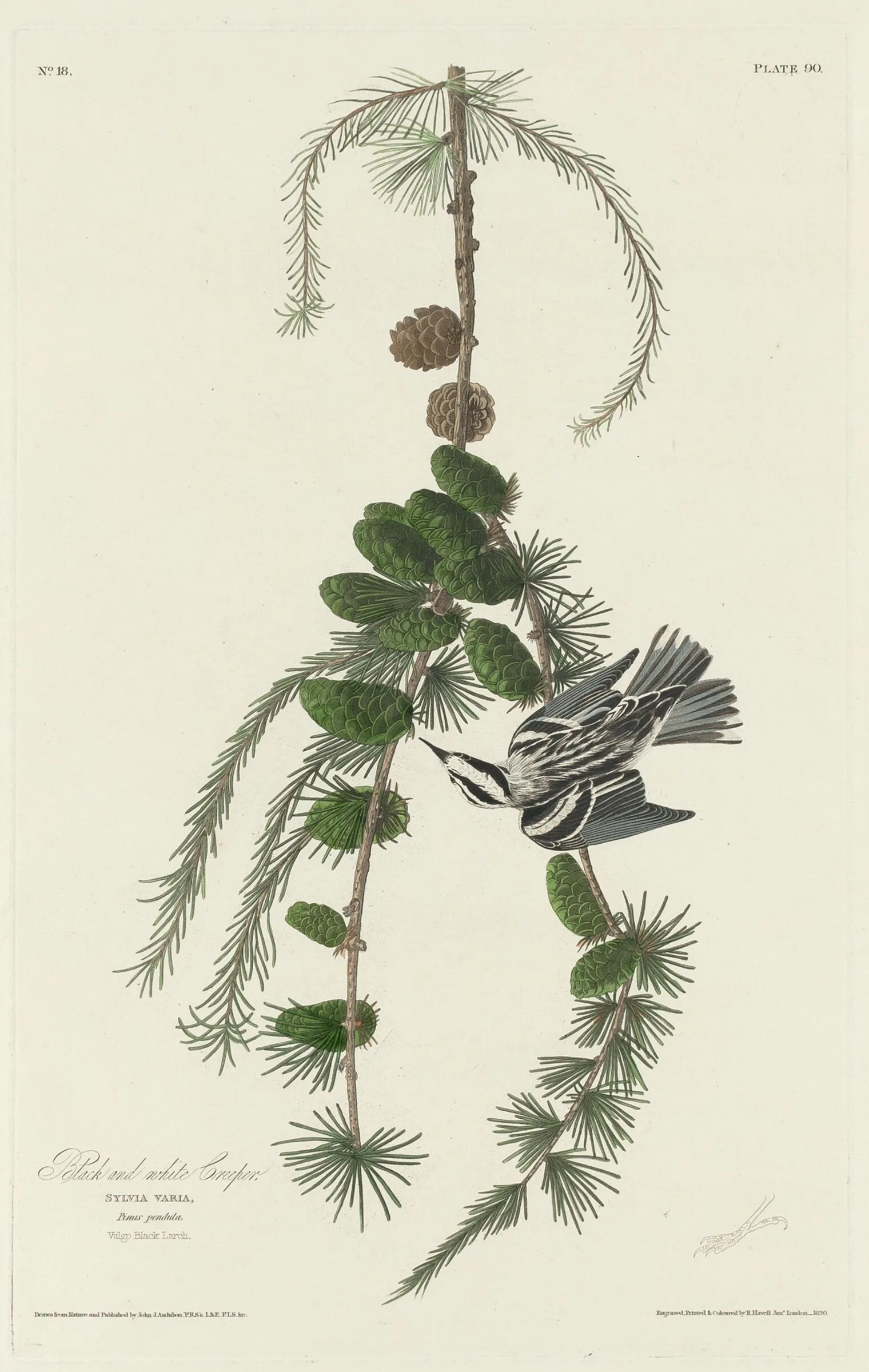
Click or press Enter to enlarge
Open the full-resolution image (2472 px, National Gallery of Art)
| Plate | 90 (XC) |
|---|---|
| Audubon's name | Black and White Creeper |
| Modern name | Black-and-white Warbler |
| Scientific name | Mniotilta varia |
| Status | Least Concern |
| Engraved by | Robert Havell, after Audubon's watercolor |
| Date | 1830 |
| Medium | Hand-colored engraving and aquatint on Whatman wove paper |
| Plants and setting | Black larch, or tamarack (Larix laricina) |
| Collections | Songbirds |
| This impression | National Gallery of Art, Washington, 1945.8.90; Gift of Mrs. Walter B. James |
About this plate
Plate 90 shows a male Black-and-white Warbler, boldly striped in black and white, on a twig of black larch, the tree now called tamarack. Audubon noted that the larch grows in cedar swamps of the northern states and drops its needles in winter.
Audubon kept the bird among the creepers because it climbs trunks and branches like a nuthatch or Brown Creeper, spiralling up and down with its head above or below and taking small ants and larvae from the bark. He said he could not remember ever seeing it perch. He wrote that it reaches Louisiana in mid-February, when the buds open, and stays to breed until November.
Modern classification agrees with Wilson's bill rather than Audubon's view of its habits: it is a New World warbler, the only member of the genus Mniotilta. It breeds in deciduous and mixed forest across Canada and the eastern United States, nests on the ground, and winters from Florida and Mexico to northern South America. Its thin, squeaky weesee song is one of the first warbler songs of spring. The chapter is followed by Audubon's essay The Eccentric Naturalist. The species is listed as Least Concern.
In Audubon's words
The Black-and-white Creeper appears in the State of Louisiana as soon as the buds on the trees begin to expand, which happens about the middle of February. It throws itself into the forests, where it breeds, and remains until the beginning of November. It is usually seen on the largest trees of our woods. It has a few notes, consisting of a series of rapidly enunciated tweets, the last greatly prolonged. It climbs and creeps along the trunks, the branches, and even the twigs of the trees, without intermission, and so seldom perches, that I do not remember ever having seen it in such a position. It lives principally on small ants and their larvæ, which it secures as it ascends or descends in a spiral direction, sidewise, with the head either uppermost or beneath.
John James Audubon, Ornithological Biography, vol. 1 (1831), “The Black-and-white Creeper”. Read the full chapter.



