Broad-winged Hawk (Plate 91)
Audubon's “Broad-winged Hawk”, The Birds of America, plate XCI
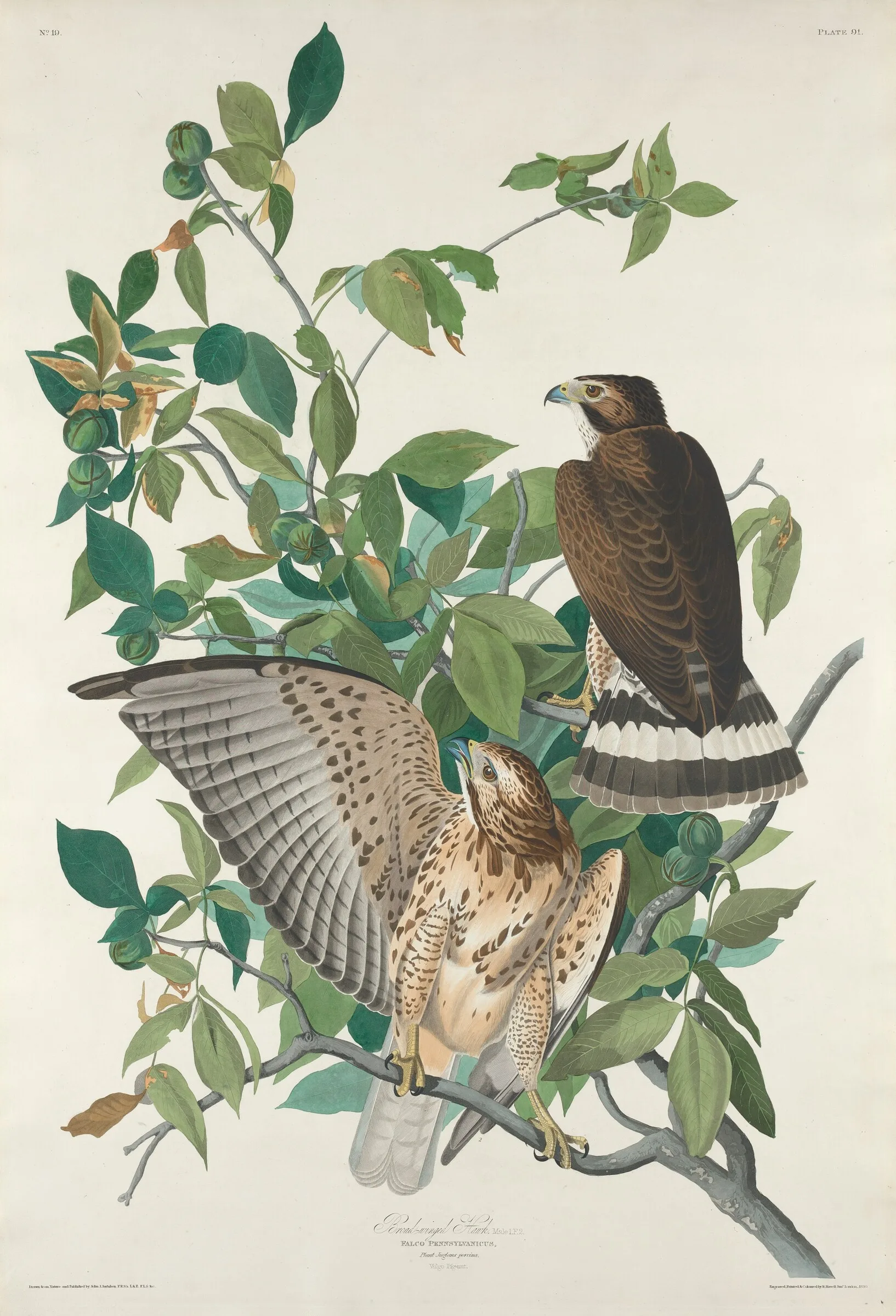
Click or press Enter to enlarge
Open the full-resolution image (4716 px, National Gallery of Art)
| Plate | 91 (XCI) |
|---|---|
| Audubon's name | Broad-winged Hawk |
| Modern name | Broad-winged Hawk |
| Scientific name | Buteo platypterus |
| Status | Least Concern |
| Engraved by | Robert Havell, after Audubon's watercolor |
| Date | 1830 |
| Medium | Hand-colored engraving and aquatint on Whatman wove paper |
| Size | plate: 96.2 x 65 cm (37 7/8 x 25 9/16 in.) sheet: 100.7 x 67.8 cm (39 5/8 x 26 11/16 in.) |
| Plants and setting | Pignut hickory (Carya glabra) |
| Collections | Hawks, Eagles and Falcons |
| This impression | National Gallery of Art, Washington, 1945.8.91; Gift of Mrs. Walter B. James |
About this plate
Plate 91 shows a male and female Broad-winged Hawk on a branch of pignut hickory. Audubon explained that he chose the tree not because the hawks eat its nuts, as some viewers assumed, but because it is common where they live and he had found their nests on it more often than on any other tree.
He told how he got his first specimen. On a May morning near Fatland Ford, Pennsylvania, he and his young brother-in-law William G. Bakewell found a bird sitting on a nest. Bakewell climbed the tree and brought it down in a handkerchief with the eggs, and it never tried to defend itself. Audubon set it on a stick on his table and drew it while it sat still and let him smooth its feathers. He wrote that the drawing was dated 27 May 1812.
The Broad-winged Hawk is a small, chunky buteo of eastern deciduous forest, with broad black and white tail bands. It is best known for its autumn migration: hundreds of thousands gather in rising columns of birds, called kettles, over ridges such as Hawk Mountain and along the Gulf coast of Texas and Veracruz, on their way to Central and South America. It is listed as Least Concern.
In Audubon's words
As we crossed a narrow skirt of wood, my young companion spied a nest on a tree of moderate height, and, as my eye reached it, we both perceived that the parent bird was sitting in it. Some little consultation took place, as neither of us could determine whether it was a Crow's or a Hawk's nest, and it was resolved that my young friend should climb the tree, and bring down one of the eggs. On reaching the nest, he said the bird, which still remained quiet, was a Hawk and unable to fly. I desired him to cover it with his handkerchief, try to secure it, and bring it down, together with the eggs. All this was accomplished without the least difficulty. I looked at it with indescribable pleasure, as I saw it was new to me, and then felt vexed that it was not of a more spirited nature, as it had neither defended its eggs nor itself.
John James Audubon, Ornithological Biography, vol. 1 (1831), “The Broad-winged Hawk”. Read the full chapter.