Merlin (Plate 92)
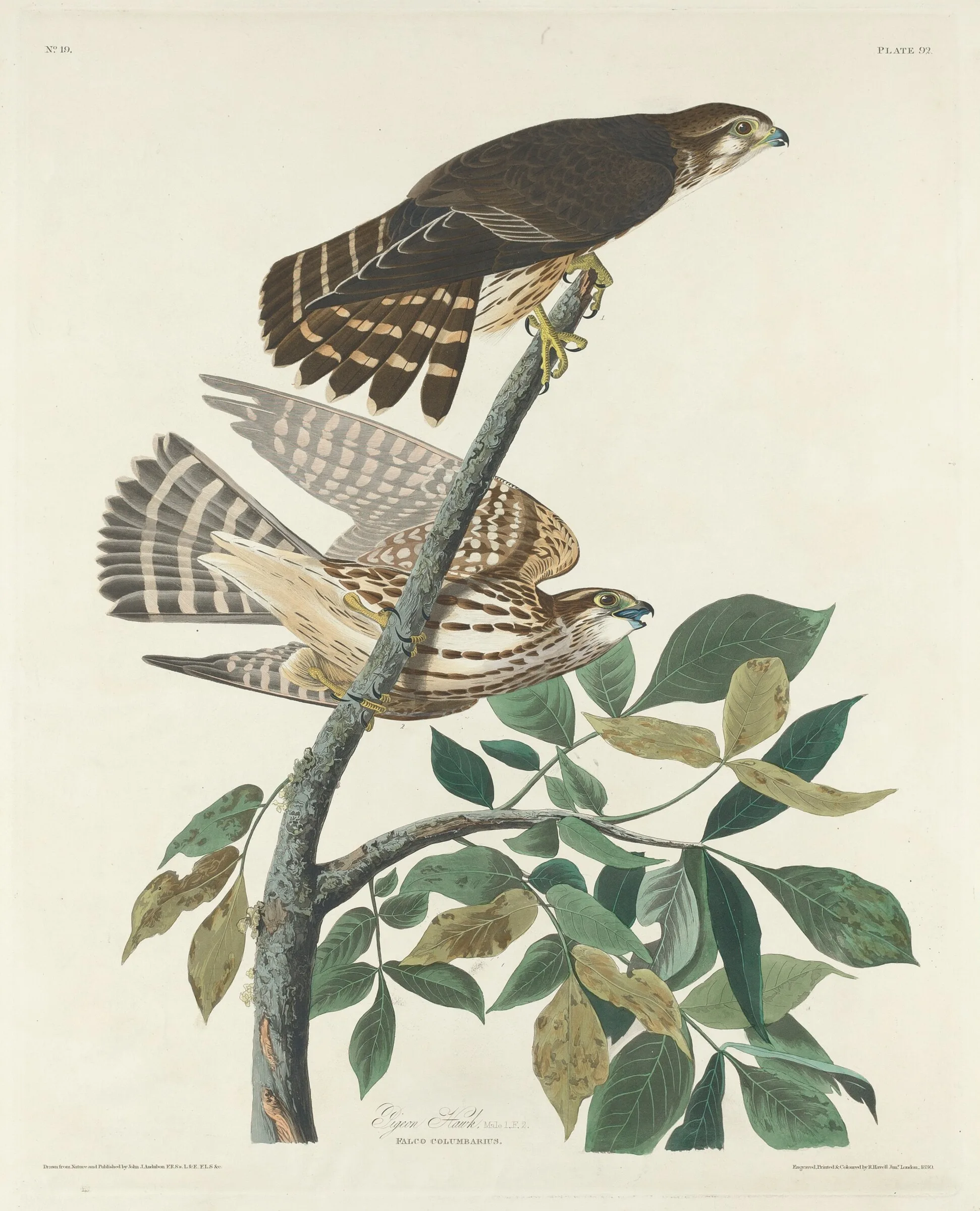
Audubon's “Pigeon Hawk”, The Birds of America, plate XCII
Click or press Enter to enlarge
Open the full-resolution image (3264 px, National Gallery of Art)
| Plate | 92 (XCII) |
|---|---|
| Audubon's name | Pigeon Hawk |
| Modern name | Merlin |
| Scientific name | Falco columbarius |
| Status | Least Concern |
| Engraved by | Robert Havell, after Audubon's watercolor |
| Date | 1830 |
| Medium | Hand-colored engraving and aquatint on Whatman wove paper |
| Collections | Hawks, Eagles and Falcons |
| This impression | National Gallery of Art, Washington, 1945.8.92; Gift of Mrs. Walter B. James |
About this plate
Plate 92 shows a male and female Merlin, which Audubon called the Pigeon Hawk. The male is slate blue above with a banded tail, and the female is dark brown. Both are heavily streaked below.
Audubon set the scene on the eastern rivers in autumn, when the marshes fill with migrating Bobolinks, Red-winged Blackbirds and Soras and sportsmen turn out for them. He described the Merlin sweeping in at dusk, scattering whole flocks into tight, twisting masses, and seizing one bird after another. The chapter's opening invites the reader to imagine standing on the shore with a gun to watch it.
This is the same species as Audubon's Le Petit Caporal, plate 75, which he took for a new falcon. The Merlin is a compact, fast falcon that hunts small birds in level, direct flight rather than in long stoops. It breeds in the boreal forests, taiga and prairies of North America and Eurasia, and North American birds winter from the southern United States to northern South America. After declines during the DDT era it has recovered and colonised many northern cities. It is listed as Least Concern.
In Audubon's words
Imagine yourself, good-natured reader, with a gun on your shoulder, following the windings of one of those noble streams which embellish our country and facilitate its commerce, having constantly within your view millions of birds on their way to the south, and which in the evenings fall thick as the drops of a hail-shower on the bordering marshes, to spend the night there in security, and by rest to restore the vigour necessary for their gaining the distant regions, whence half of them had emerged the preceding spring. Well, as you are proceeding, full of anxiety, and gazing in astonishment at the multitudes of feathered travellers, all of a sudden a larger bird attracts your eye. It sweeps along in the stillness of the autumnal evening with a rapidity seldom equalled, creating confusion, terror, and dismay along the whole shores.
John James Audubon, Ornithological Biography, vol. 1 (1831), “The Pigeon Hawk”. Read the full chapter.