Seaside Sparrow (Plate 93)
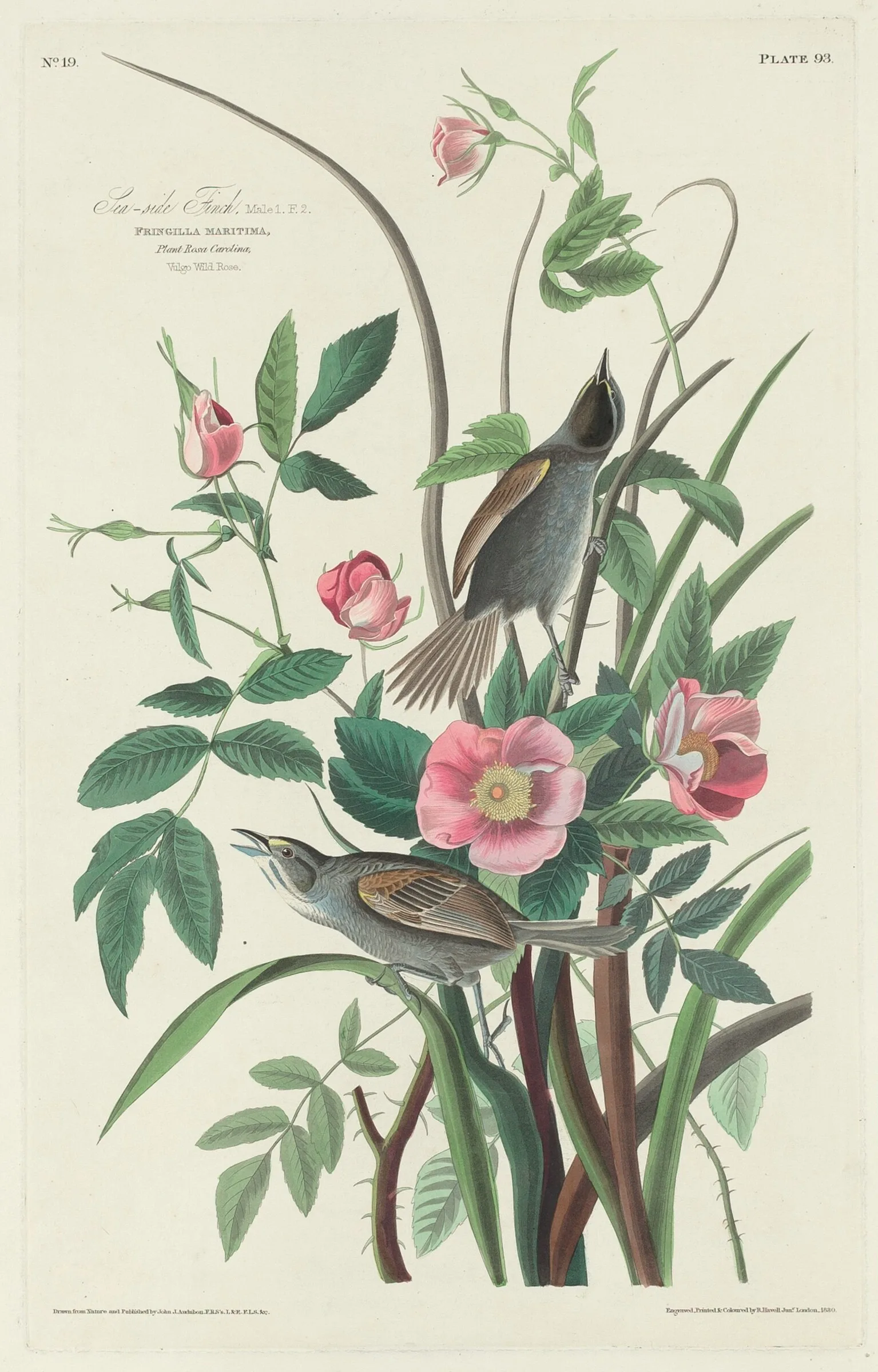
Audubon's “Sea-side Finch”, The Birds of America, plate XCIII
Click or press Enter to enlarge
Open the full-resolution image (2492 px, National Gallery of Art)
| Plate | 93 (XCIII) |
|---|---|
| Audubon's name | Sea-side Finch |
| Modern name | Seaside Sparrow |
| Scientific name | Ammospiza maritima |
| Status | Least Concern |
| Engraved by | Robert Havell, after Audubon's watercolor |
| Date | 1830 |
| Medium | Hand-colored engraving and aquatint on Whatman wove paper |
| Plants and setting | Carolina rose (Rosa carolina) |
| Collections | Songbirds |
| This impression | National Gallery of Art, Washington, 1945.8.93; Gift of Mrs. Walter B. James |
About this plate
Plate 93 shows a male and female Seaside Sparrow on a Carolina rose. Audubon explained that the rose grows on slightly higher ground just above the salt marshes, where the sparrows take refuge when very high tides cover the grass, so it made a fitting setting.
He described the monotonous chirping heard all over the Atlantic salt marshes in May and June, made by this bird and a close relative, and the male singing from the tops of rank weeds at the edge of tidal water. When approached, the bird slips down the stalks into the grass or flutters off and runs. He found nests close to the ground, built of coarse grass, and thought the birds raised two broods. He noted that the flesh tasted too fishy to eat.
The Seaside Sparrow lives only in coastal salt marshes from Massachusetts to Texas. Rising sea levels and marsh loss threaten many populations. One subspecies, the Dusky Seaside Sparrow of Florida's Merritt Island and St Johns River marshes, was driven extinct by marsh flooding for mosquito control and by drainage; the last bird died in 1987. The Cape Sable Seaside Sparrow of the Everglades is federally endangered. The species is listed as Least Concern.
In Audubon's words
The monotonous chirpings which one hears in almost every part of our maritime salt-marshes, are produced by this bird and another nearly allied to it. The Sea-side Finch may be seen at any hour of the day, during the months of May and June, mounted on the tops of the rankest weeds which grow by the margins of tide-waters along the greater portion of our Atlantic coast, whence it pours forth with much emphasis the few notes of which its song is composed. When one approaches it, it either seeks refuge amongst the grass, by descending along the stalks and blades of the weeds, or flies off to a short distance, with a continued flirting of its wings, then alights with a rapid descent, and runs off with great nimbleness.
John James Audubon, Ornithological Biography, vol. 1 (1831), “The Sea-side Finch”. Read the full chapter.



