Vesper Sparrow (Plate 94)
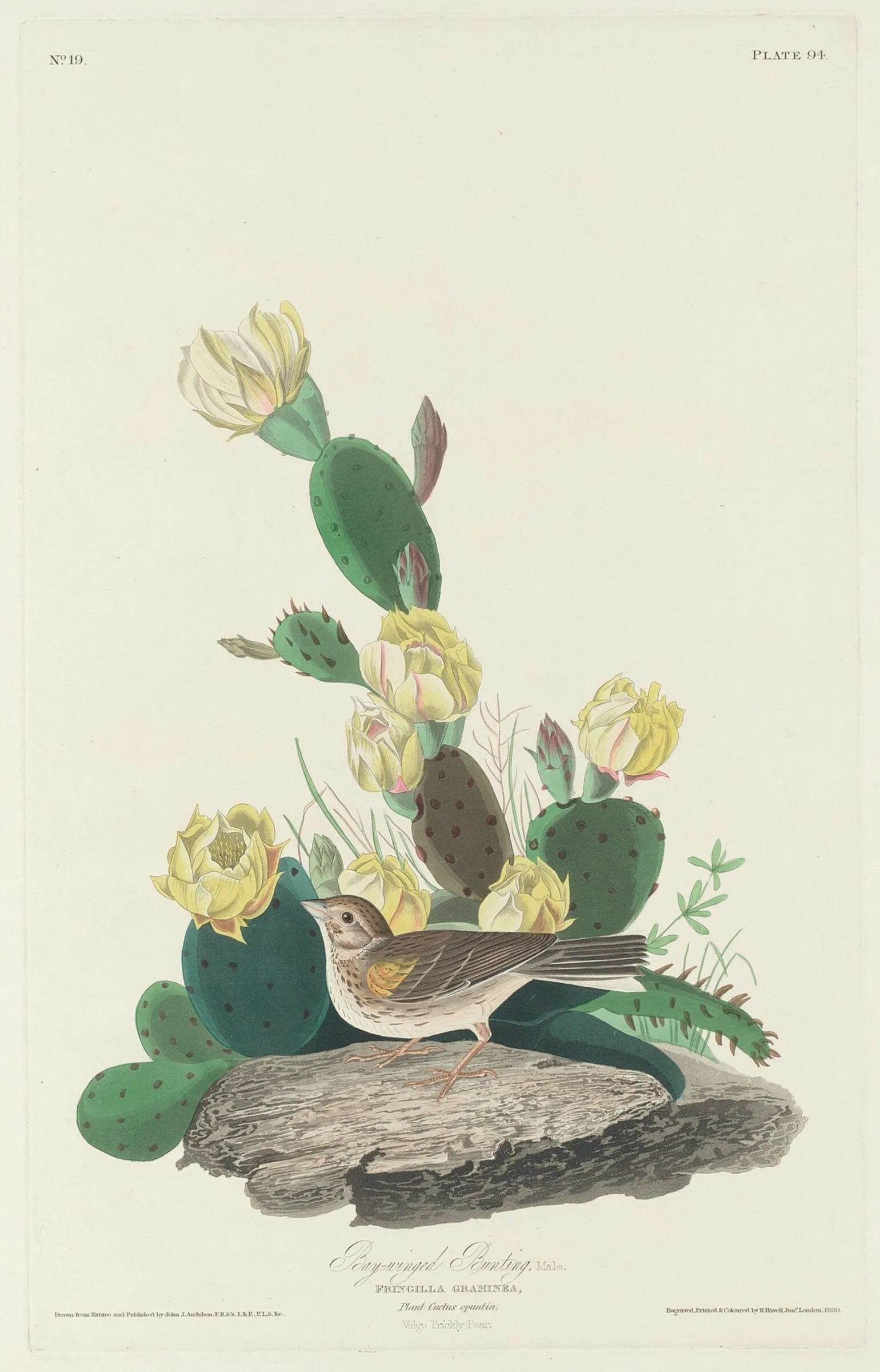
Audubon's “Bay-winged Bunting”, The Birds of America, plate XCIV
Click or press Enter to enlarge
Open the full-resolution image (2465 px, National Gallery of Art)
| Plate | 94 (XCIV) |
|---|---|
| Audubon's name | Bay-winged Bunting |
| Modern name | Vesper Sparrow |
| Scientific name | Pooecetes gramineus |
| Status | Least Concern |
| Engraved by | Robert Havell, after Audubon's watercolor |
| Date | 1830 |
| Medium | Hand-colored engraving and aquatint on Whatman wove paper |
| Plants and setting | Prickly pear (Opuntia) |
| Collections | Songbirds |
| This impression | National Gallery of Art, Washington, 1945.8.94; Gift of Mrs. Walter B. James |
About this plate
Plate 94 shows a male Vesper Sparrow among prickly pear cactus. Audubon wrote that he drew the bird near the seashore of New Jersey, where he shot it walking among clumps of prickly pear growing in dry sand, so he included the plant. He added that he had seen related cactus on the cliffs of the Kentucky River near Frankfort and in Louisiana.
Audubon called it the Grass Finch or Bay-winged Bunting, for the chestnut patch on the shoulder. He thought it lived only east of the Alleghenies, since he had never seen it in Louisiana, Missouri, Kentucky or Ohio, and he noted its taste for sandy, dry ground. He described a sweet song given for half an hour from sassafras, sumac or a fence rail, dust bathing in warm sand, and a nest in the grass partly sunk in the ground.
The bird is now called the Vesper Sparrow because it often sings at dusk. Its white outer tail feathers flash when it flies. Audubon's sense of its range was wrong: it breeds across much of Canada and the northern and western United States in fields, pastures and sagebrush, and winters in the southern states and Mexico. Its eastern populations have declined with the loss of farmland and fallow fields. It is listed as Least Concern.
In Audubon's words
It sings sweetly, and at times for half-an-hour, without changing its place, either from the tops of the Sassafras or Sumach bushes which grow along the fences, or from the upper bar or stake of a fence itself. During this little serenade, it is easily approached, but when on the ground, where it runs nimbly and with grace, it is rather shy. It is fond of scratching in the warm and dry sand, and of wallowing in it, to cleanse its body. Its flight, which is easy, consists of a succession of gentle undulations, and, when it is chased, sometimes extends over the whole of a field. It is a solitary bird, and is rather pugnacious, for when two males or two females happen to meet, little skirmishes frequently ensue.
John James Audubon, Ornithological Biography, vol. 1 (1831), “The Grass Finch, or Bay-winged Bunting”. Read the full chapter.



