Yellow Warbler (Plate 95)
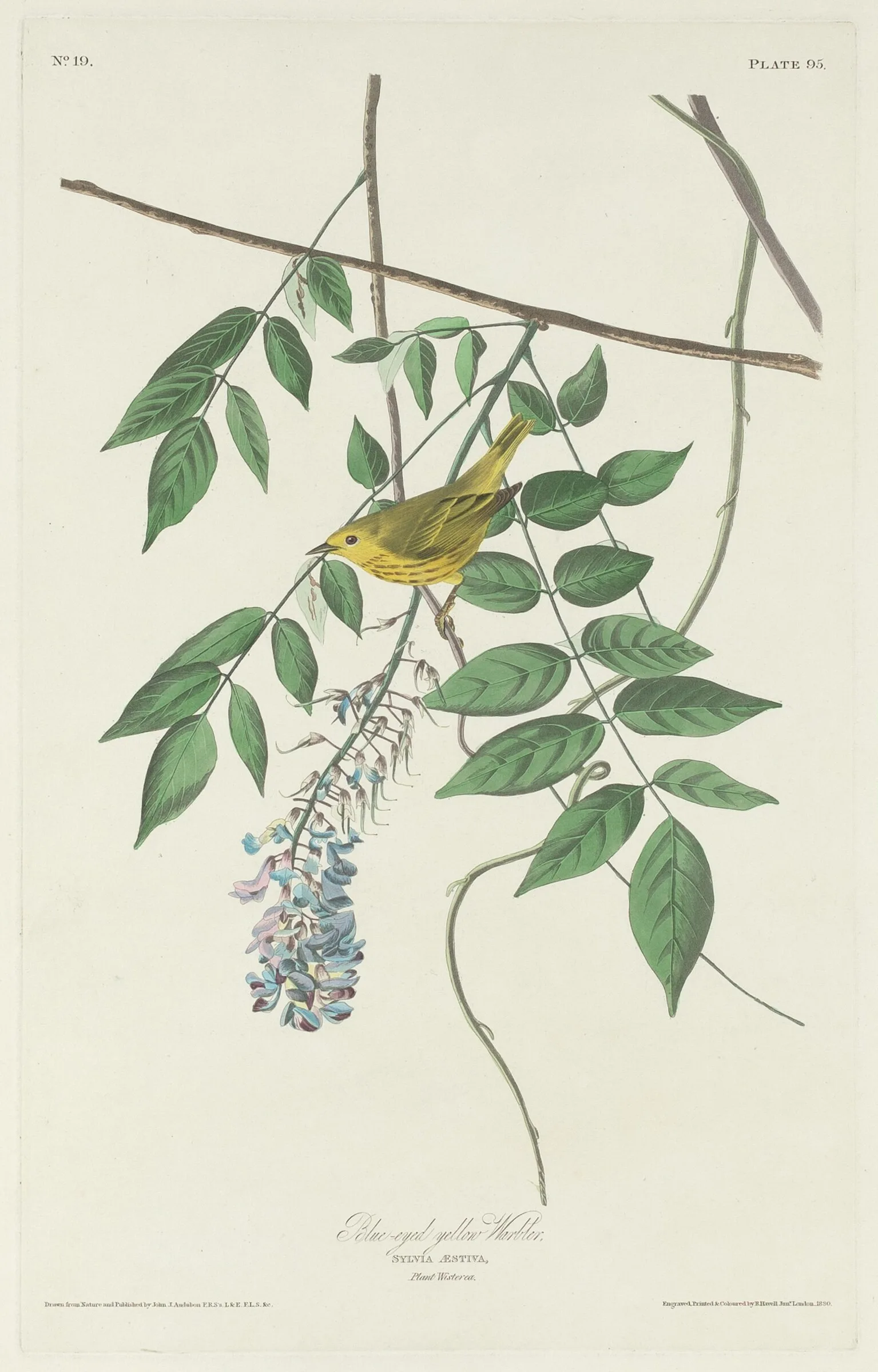
Audubon's “Blue-eyed Yellow Warbler”, The Birds of America, plate XCV
Click or press Enter to enlarge
Open the full-resolution image (2487 px, National Gallery of Art)
| Plate | 95 (XCV) |
|---|---|
| Audubon's name | Blue-eyed Yellow Warbler |
| Modern name | Yellow Warbler |
| Scientific name | Setophaga petechia |
| Status | Least Concern |
| Engraved by | Robert Havell, after Audubon's watercolor |
| Date | 1830 |
| Medium | Hand-colored engraving and aquatint on Whatman wove paper |
| Plants and setting | A climbing vine with pale purple flower clusters, drawn near Natchez |
| Collections | Songbirds |
| This impression | National Gallery of Art, Washington, 1945.8.95; Gift of Mrs. Walter B. James |
About this plate
Plate 95 shows a male Yellow Warbler, bright yellow with red streaks on the breast, among the hanging pale purple flower clusters of a climbing vine. Audubon wrote that he drew it near Natchez, Mississippi, after shooting it as it searched those flowers for insects, and that the vine grows only in low, damp ground, spreading over dead trees like a bower.
The plate title, Blue-eyed Yellow Warbler, follows Alexander Wilson's Blue-eyed Warbler, while the text calls the bird the Yellow-poll Warbler. Audubon described it following the Purple Martin into Louisiana in spring, feeding in gardens, orange groves and willows by the lagoons, and moving east and north mostly by night. He noted that it nests in every orchard and garden from New York to Virginia and tries to lead intruders away from the nest.
The Yellow Warbler breeds across almost all of North America, from Alaska to Mexico, in willow and alder thickets, wet edges and gardens. It is known for its response to the Brown-headed Cowbird: when a cowbird egg appears, the warbler often builds a new nest floor on top, sometimes stacking several layers. It winters from Mexico to northern South America. Audubon also painted it as the Rathbone Warbler, plate 65. It is listed as Least Concern.
In Audubon's words
As soon as the welcome note of the Purple Martin is heard in spring, on its return to the United States, which, in Louisiana, sometimes takes place early in March, the little Warbler here presented to your inspection follows, and is seen gaily moving from tree to tree, feeding on the smaller insects, and tuning its pipe, which, however, is not the most melodious. It approaches the gardens and orange-groves, and again flies off to the willows, along the margins of the pools and lagoons. Its sojourn is of short duration in Louisiana, for it moves gradually eastward as the season advances, leaving nothing but the recollection of its passage through the land. Its migration, in as far as I have been able to ascertain, is principally performed during the night.
John James Audubon, Ornithological Biography, vol. 1 (1831), “The Yellow-poll Warbler”. Read the full chapter.



