Black-throated Magpie-Jay (Plate 96)
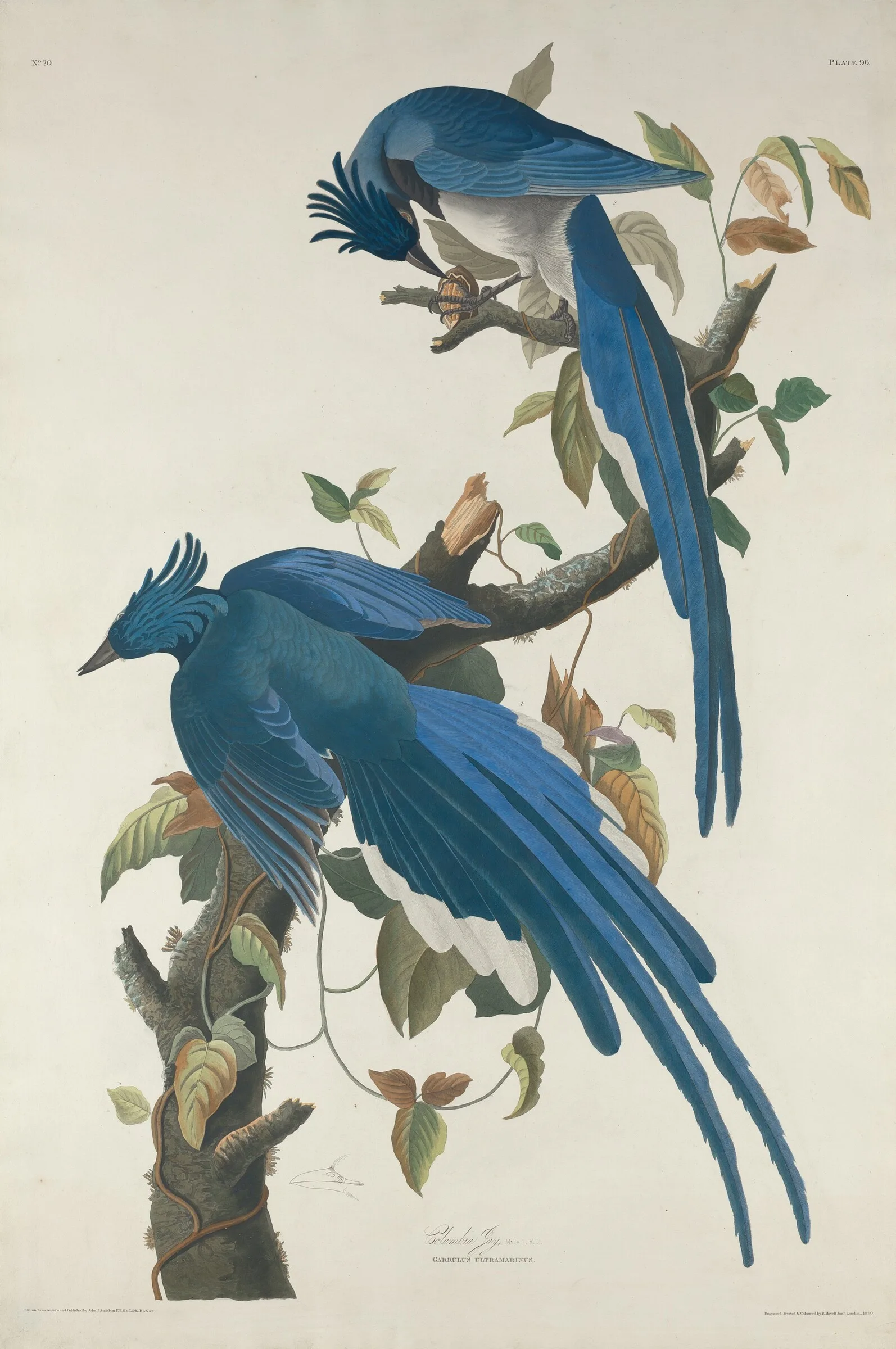
Audubon's “Columbia Jay”, The Birds of America, plate XCVI
Click or press Enter to enlarge
Open the full-resolution image (4719 px, National Gallery of Art)
| Plate | 96 (XCVI) |
|---|---|
| Audubon's name | Columbia Jay |
| Modern name | Black-throated Magpie-Jay |
| Scientific name | Calocitta colliei |
| Status | Least Concern |
| Engraved by | Robert Havell, after Audubon's watercolor |
| Date | 1830 |
| Medium | Hand-colored engraving and aquatint on Whatman wove paper |
| Size | plate: 97 x 64 cm (38 3/16 x 25 3/16 in.) sheet: 99.7 x 66.7 cm (39 1/4 x 26 1/4 in.) |
| Collections | Songbirds |
| This impression | National Gallery of Art, Washington, 1945.8.96; Gift of Mrs. Walter B. James |
About this plate
Plate 96 shows a single magpie-jay with a tall, curled crest, bright blue upperparts, a black throat and breast, white underparts and an extremely long, graduated tail. Audubon gave its length as thirty-one inches, most of it tail.
This is the one bird in the first volume that Audubon did not collect himself. He wrote that a friend gave him the specimen, which had come from the Columbia River, and that he had decided to report only his own observations, so he said almost nothing about its habits. He used the chapter instead to discuss how the jays differ from the crows. A note from Charles Bonaparte, Prince of Musignano, added that the German zoologist Johann Wagler had already described the bird.
The Columbia River origin was wrong. The bird is the Black-throated Magpie-Jay, which lives only in the dry forests and thorn scrub of northwestern Mexico, from Sonora to Jalisco, and has never been recorded naturally in the Pacific Northwest. Its inclusion in a work on the birds of America therefore rests on a mislabelled specimen. Magpie-jays live in noisy family groups in which helpers assist the breeding pair. It is listed as Least Concern.
In Audubon's words
Were I to relate to you, good reader, the various accounts which I have heard respecting this splendid bird, I should have enough to say; but as I have resolved to confine myself entirely to the results of my own observation, I must for the present remain silent on the subject. The specimen from which the drawings were taken was presented to me by a friend who had received it from the Columbia River, and is the only individual represented in the volume which I did not myself procure on the spot. However, as I expect to ramble again through our vast forests and extensive territories, I may yet be enabled to give you a full account of this beautiful bird, which, from the splendour of its plumage, deserves all the attention of the naturalist.
John James Audubon, Ornithological Biography, vol. 1 (1831), “The Columbia Jay”. Read the full chapter.



