Eastern Screech-Owl (Plate 97)
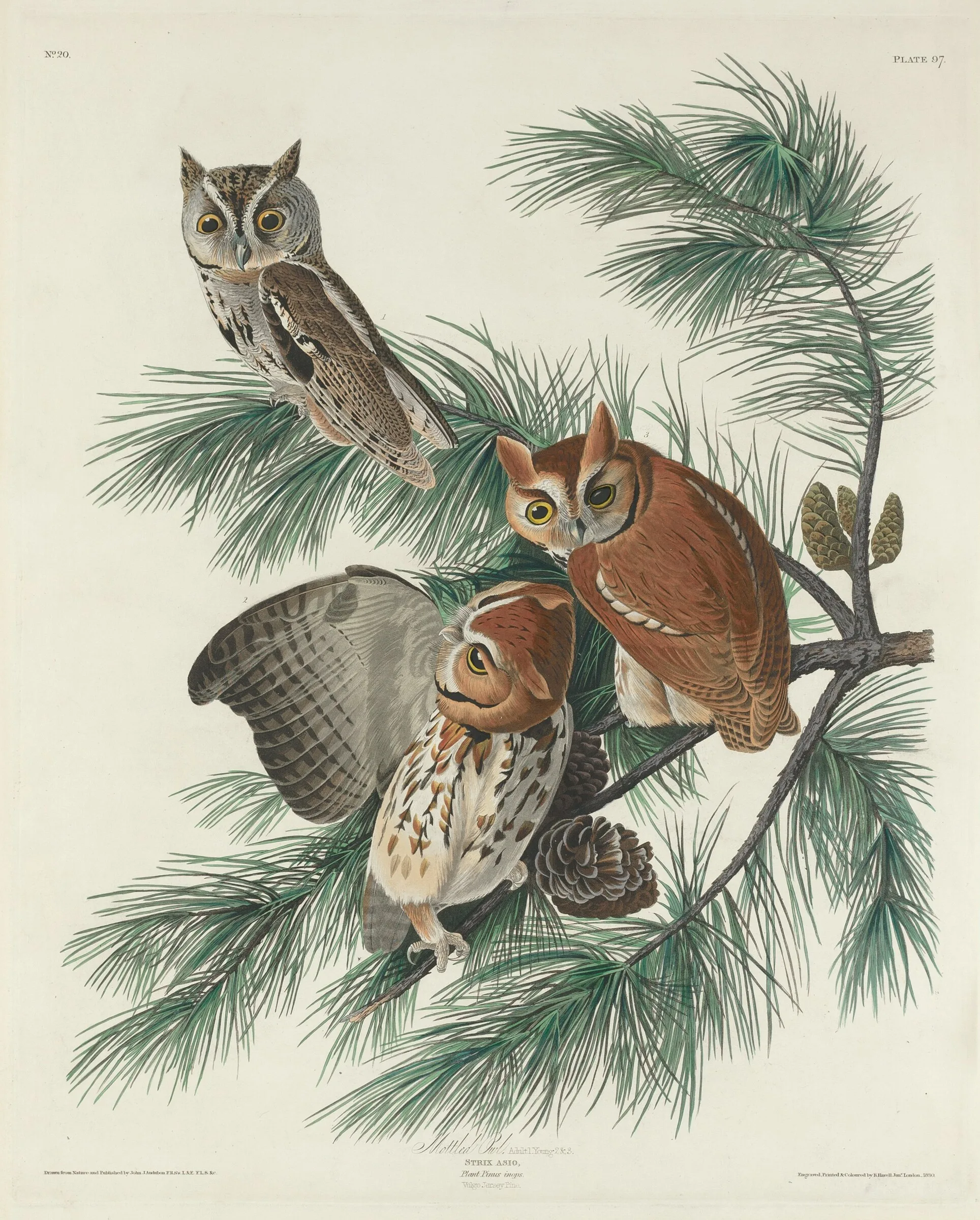
Audubon's “Mottled Owl”, The Birds of America, plate XCVII
Click or press Enter to enlarge
Open the full-resolution image (3250 px, National Gallery of Art)
| Plate | 97 (XCVII) |
|---|---|
| Audubon's name | Mottled Owl |
| Modern name | Eastern Screech-Owl |
| Scientific name | Megascops asio |
| Status | Least Concern |
| Engraved by | Robert Havell, after Audubon's watercolor |
| Date | 1830 |
| Medium | Hand-colored engraving and aquatint on Whatman wove paper |
| Size | overall: 99.4 x 67 cm (39 1/8 x 26 3/8 in.) |
| Plants and setting | Jersey pine, or Virginia pine (Pinus virginiana) |
| Collections | Owls |
| This impression | National Gallery of Art, Washington, 1945.8.97; Gift of Mrs. Walter B. James |
About this plate
Plate 97 shows three Eastern Screech-Owls on a branch of Jersey pine: one grey bird and two rufous birds. Audubon wrote that the pine is a scrubby tree that grows in large groves in New Jersey and was mostly cut for steamboat fuel, and that the owl often perches on it.
Audubon arranged the plate to settle a dispute. Alexander Wilson had described a Red Owl and a Mottled Owl as separate species. Audubon, following Charles Bonaparte, showed the grey bird as the adult and the red birds as its young. Both views were partly wrong. The red and grey birds are colour morphs of one species, and each keeps its colour for life regardless of age. Audubon's heading name, Little Screech Owl, is closer to today's name than the plate title.
He described the owl as rare in Louisiana but common along the upper Ohio and in the East, where its mournful trill was heard on mild nights. He carried one of the young birds shown in his coat pocket from Philadelphia to New York; it was a gift from Dr Richard Harlan and fed from his hand. The Eastern Screech-Owl lives in woods, farms and suburbs east of the Rockies, nests in tree holes and nest boxes, and is listed as Least Concern.
In Audubon's words
I carried one of the young birds represented in the Plate, in my coat pocket, from Philadelphia to New York, travelling alternately by water and by land. It remained generally quiet, fed from the hand, and never attempted to escape. It was given me by my good friend Dr Richard Harlan, of Philadelphia, and was lost at sea, in the course of my last voyage to England. The notes of this Owl are uttered in a tremulous, doleful manner, and somewhat resemble the chattering of the teeth of a person under the influence of extreme cold, although much louder. They are heard at a distance of several hundred yards, and by some people are thought to be of ominous import. The little fellow is generally found about farm-houses, orchards, and gardens.
John James Audubon, Ornithological Biography, vol. 1 (1831), “The Little Screech Owl”. Read the full chapter.