Tree Swallow (Plate 98)
Audubon's “Green-blue or White-bellied Swallow”, The Birds of America, plate XCVIII
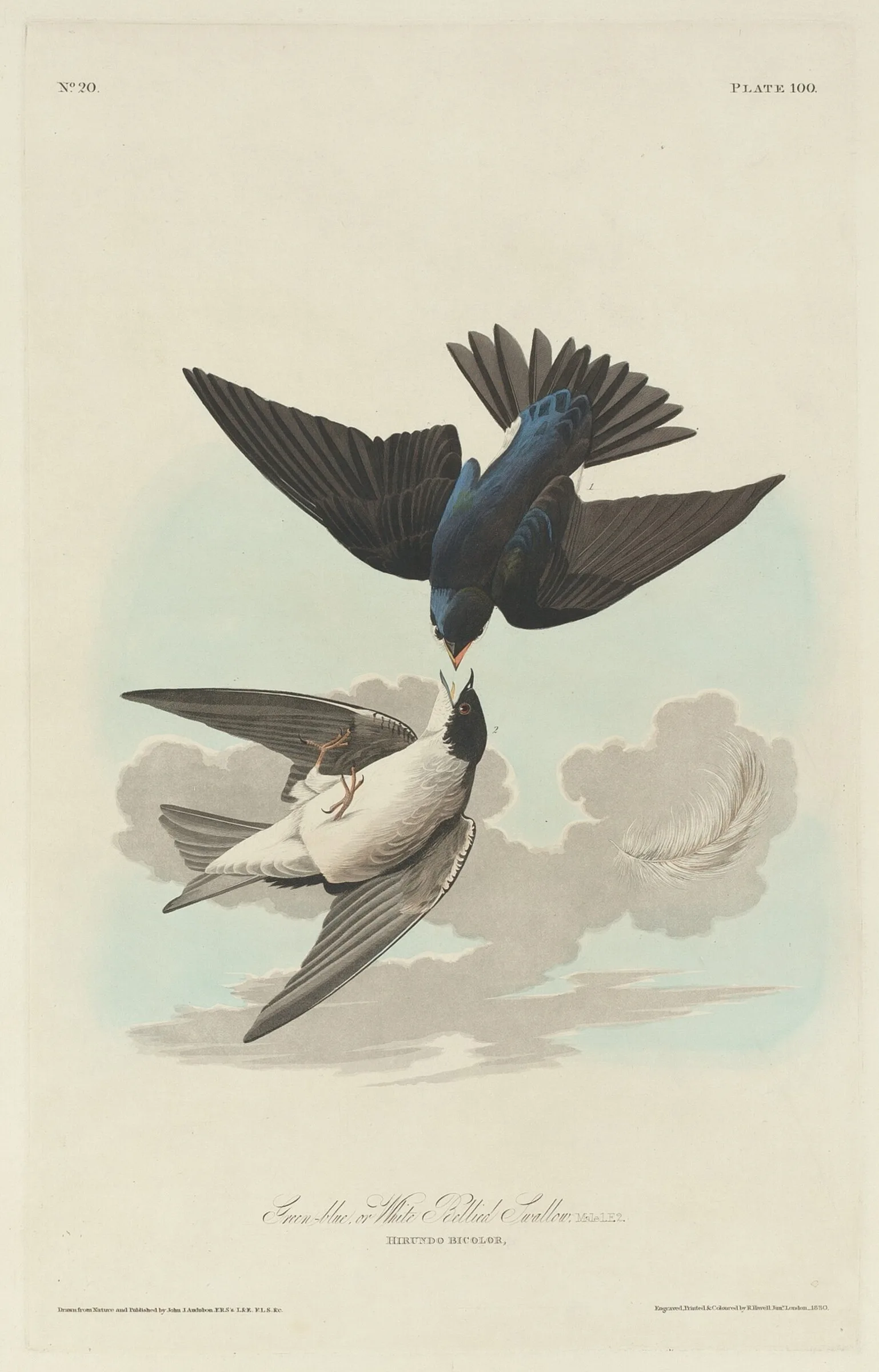
Click or press Enter to enlarge
Open the full-resolution image (2465 px, National Gallery of Art)
| Plate | 98 (XCVIII) |
|---|---|
| Audubon's name | Green-blue or White-bellied Swallow |
| Modern name | Tree Swallow |
| Scientific name | Tachycineta bicolor |
| Status | Least Concern |
| Engraved by | Robert Havell, after Audubon's watercolor |
| Date | 1830 |
| Medium | Hand-colored engraving and aquatint on Whatman wove paper |
| Collections | Songbirds |
| This impression | National Gallery of Art, Washington, 1945.8.100; Gift of Mrs. Walter B. James |
About this plate
Plate 98 shows a male and female Tree Swallow, glossy steel blue and green above and pure white below. The title follows Alexander Wilson's name, the Green-blue or White-bellied Swallow. The engraved numbers of plates 98 and 100 were misnumbered on the Havell edition, so some collections, including the National Gallery of Art, list the White-bellied Swallow and the Marsh Wren under each other's numbers.
Audubon wrote that this swallow often spends the winter in Louisiana, around the marshes of Lake Pontchartrain and Bayou St John near New Orleans. In spring it spreads widely and hunts over city streets and meadows, snapping up insects with an audible click. He found it quarrelsome, fighting with its own kind and taking over the nests of what he called the House Swallow, and he described its nest in a tree hollow, made of grass and thickly lined with feathers.
The Tree Swallow is the hardiest North American swallow. It returns north earlier than other swallows and winters farther north, along the Gulf and southern Atlantic coasts, because it can switch from insects to the waxy berries of bayberry and wax myrtle in cold weather. It breeds across Canada, Alaska and the northern United States, nests in old woodpecker holes and nest boxes, and has been widely used in field studies of bird biology. It is listed as Least Concern.
In Audubon's words
This Swallow often spends the winter months in the State of Louisiana, resorting principally to the neighbourhood of the marshes that border the lakes of Pont Chartrain and those of Bayou St John, near the city of New Orleans, an account of which I have already given when speaking of the Republican Swallow. At the beginning of spring, it spreads widely over the country, and may be observed skimming over the streets of our cities, as well as along the meadows in their neighbourhood. Its flight is easy, continued, and capable of being greatly protracted. It is seen sailing, circling, turning, and winding in all directions, during the greater part of the day. Like all other Swallows, it feeds on the wing, unceasingly pursuing insects of various kinds, and in seizing them producing a snapping noise which may be heard at some distance.
John James Audubon, Ornithological Biography, vol. 1 (1831), “The White-bellied Swallow”. Read the full chapter.
Other impressions of this plate: The Metropolitan Museum of Art.



